

Practice on 2025 LATEST HPE0-S59 Exam Updated 113 Questions
Download Latest HPE0-S59 Dumps with Authentic Real Exam QA's
To pass the HP HPE0-S59 exam, you must have a strong understanding of HPE compute solutions, including HPE ProLiant, HPE Synergy, and HPE Apollo systems. You must also have a good understanding of HPE server management tools, HPE server security, and HPE server virtualization technologies.
NEW QUESTION # 65
A logical interconnect group can span on multiple HPE Synergy frames for which interconnect type?
- A. HPE virtual Connect SE 32 Gb FC Module for Synergy
- B. HPE Synergy 12 Gb SAS Connection Module
- C. HPE Virtual Connect SE 100 Gb F32 Module tor Synergy
- D. Brocade 32GB Fibre Channel Switch Module for HPE Synergy
Answer: C
NEW QUESTION # 66
In the past a customer experienced a networking issue where network ports went down and came back up in quick succession.
Which HPE Virtual Connect SE 100 GD F32 Module for HPE Synergy feature can be configured to disable such ports?
- A. sFlow
- B. Port flap protection
- C. Storm control
- D. Pause flood protection
Answer: B
Explanation:
Port flap protection is a feature of the HPE Virtual Connect SE 100Gb F32 Module for HPE Synergy that can be configured to disable ports experiencing frequent up and down transitions.
This feature helps to stabilize the network by preventing the disruptive effects of port flapping.
NEW QUESTION # 67
Your customer plans to deploy a VMware ESXi with HPE Synergy platform. They also plan a vSAN deployment leveraging HPE D3940 Storage Modules and SSD drives. The customer requested the following components:
- HPE Synergy frame with ten HPE Synergy 480 Gen10 Plus compute modules
- Two HPE Virtual Connect SE 100Gb F32 Modules for Synergy
- An appropriate number of vSAN Standard licenses for each compute node
- One HPE O3940 Storage Module with 40 SSDs - All required cables and
options
Which statement about this request is true?
- A. vSphere licenses should be added, as vSAN licenses do not replace vSphere licenses
- B. vSphere Standard licenses should be replaced with Enterprise Plus licenses to enable vSAN
- C. 20 SSD drives should be removed from this setup, as D3940 supports only 20 SSD or SAS drives.
- D. One HPE Virtual Connect SE 100Gb F32 Module for Synergy should be replaced with 50GD/S ILM
Answer: A
Explanation:
vSAN licenses and vSphere licenses are separate entities. While vSAN licenses cover the storage virtualization aspect of VMware's hyper-converged infrastructure, vSphere licenses are required for the actual hypervisor operations. Therefore, the customer must ensure they have the appropriate vSphere licenses in addition to vSAN licenses for their compute nodes.
NEW QUESTION # 68
Your customer plans to expand an existing nPar based on a single HPE Superdome Flex chassis. Which statement about workload availability during expansion is true?
- A. Online expansion is available only if RMC is used for management.
- B. Powered nPar can be expanded only if HPE Superdome Flex 280 is used
- C. Powered nPar can be expanded if it does not use HPE Persistent Memory
- D. HPE Superdome Flex does not support expansion of powered on nPars
Answer: C
Explanation:
HPE Superdome Flex allows for the expansion of powered-on nPars (nPartitions), but this capability is subject to certain conditions. One of these conditions is that the nPar does not use HPE Persistent Memory.
Expanding an nPar with Persistent Memory typically requires a shutdown to reconfigure the memory settings safely.
NEW QUESTION # 69
Drag and Drop Question
After HPE Superdome Flex deployment and nPar setup, you need to verify health status of HPE Superdome Flex components.
Put the steps on the left into the coned order on the right to perform this task.
Answer:
Explanation:
NEW QUESTION # 70
Click the option that will allow you to change the ESXI image used In an OS Deployment Plan.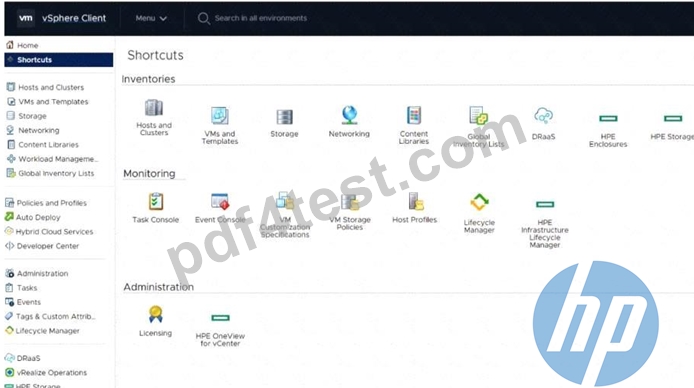
Answer:
Explanation: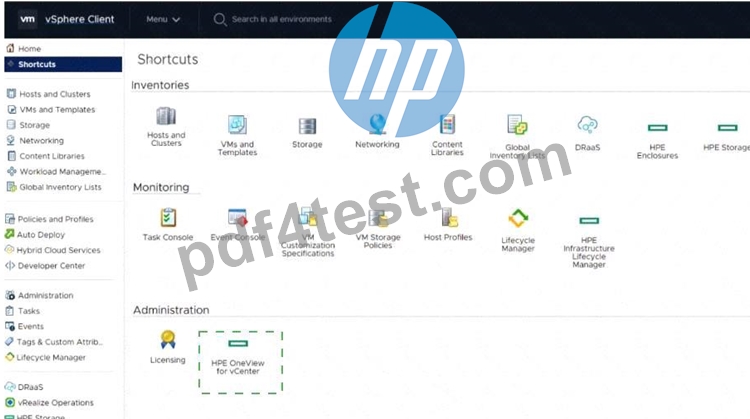
NEW QUESTION # 71
Refer to the exhibit.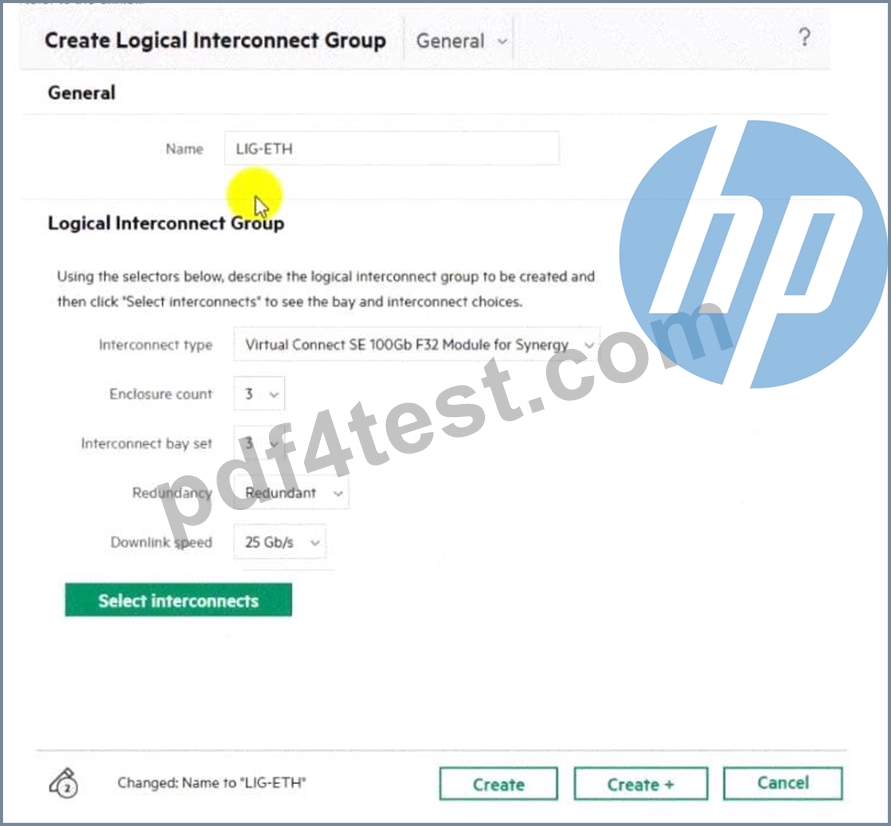
Which statement about this logical interconnect group is true?
- A. Both master modules are located in the same HPE Synergy frame
- B. To use interconnect bay set 3, all compute nodes must be half-height
- C. The master modules are located in the interconnect bays 2 and 5
- D. For the given downlink speed, the maximum number of frames is reached
Answer: B
Explanation:
In HPE Synergy configurations, when using interconnect bay set 3, it implies that the compute nodes should be half-height. This is because bay set 3 is typically utilized in configurations where half-height compute nodes are used to ensure proper alignment and connectivity within the Synergy frame.
NEW QUESTION # 72
Your customer uses HPE OneView to manage their HPE Synergy environment.
They plan to use it to manage a new set equipment that includes.
- 20 HPE ProLiant DL365 Gen10 Plus servers
- 20 HPE ProLiant DL380 Gen10 Plus servers
- 5 HPE Primera 650
- 5 HPE MSA 2062 Storage Array
Which statements about now OneView will work with this new equipment are true? (Select two)
- A. HPE ProLiant DL365 Gen10 Plus servers are not supported in HPE OneView
- B. HPE OneView replaces array management tools for both types of array
- C. HPE Primera 650 can be managed using HPE OneView.
- D. HPE ProLiant DL380 Gen10 Plus servers have an HPE OneView license included
- E. HPE MSA 2062 Storage Array is not supported in HPE OneView
Answer: C,E
Explanation:
HPE MSA 2062 Storage Array is not supported in HPE OneView: HPE OneView does not provide management capabilities for the HPE MSA series, which includes the MSA 2062. These arrays must be managed using their dedicated management tools.
HPE Primera 650 can be managed using HPE OneView: HPE OneView supports the management of HPE Primera storage arrays, including the Primera 650, allowing for integrated management and monitoring within the OneView environment.
NEW QUESTION # 73
Drag and Drop Question
Your customer plans to use HPE OneView for VMware vCenter Server to deploy ESXi systems.
They created a server profile template that they want to use in HPE OneView. Put the steps required to configure HPE OneView for VMware vCenter Server on the left into their correct order on the right.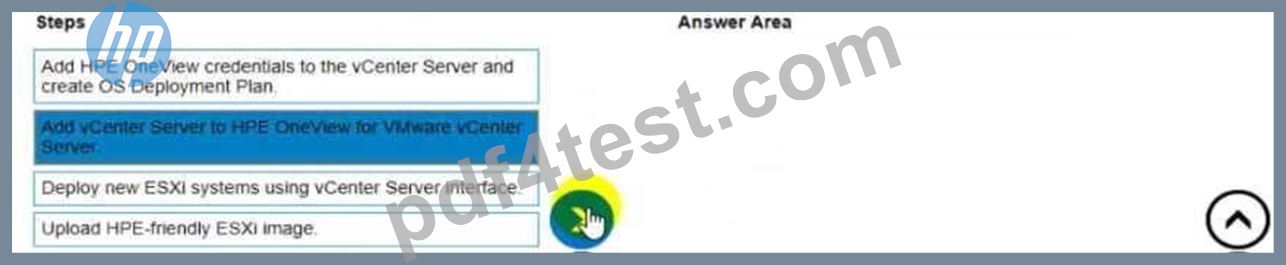
Answer:
Explanation: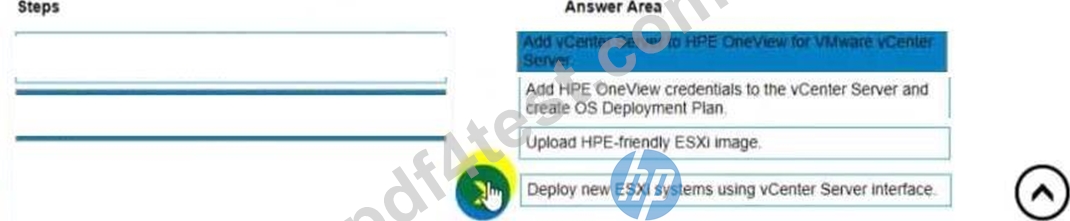
NEW QUESTION # 74
What is a restriction of using a RoCE network?
- A. It does not support smart link and private network features.
- B. it is not supported with HPE Virtual Connect SE 40 GD F8 Module for HPE Synergy.
- C. It does not support Private VLAN and Multicast VLAN.
- D. It is by default configured as an untagged network and cannot be a part of a network set.
Answer: A
Explanation:
A restriction of using a RoCE (RDMA over Converged Ethernet) network is that it does not support smart link and private network features. These features are essential for certain network configurations and use cases, but they are not available in RoCE networks, which are designed for high-performance, low-latency communication.
NEW QUESTION # 75
You are troubleshooting an HPE OneView server profile that presents a critical state.
The server profile was configured with a Link Aggregation Group.
What should you check to fix the issue?
- A. if both FiexNICs are configured with the same speed
- B. if both FiexNICs are connected to different networks
- C. if the logical enclosure is configured with redundant master modules
- D. If the logical enclosure is built on at least three HPE Synergy frames
Answer: A
Explanation:
When troubleshooting a server profile in HPE OneView that is in a critical state due to a Link Aggregation Group (LAG), it is important to check if both FlexNICs are configured with the same speed. Inconsistent speeds can cause issues with link aggregation, leading to network instability and performance degradation.
NEW QUESTION # 76
Drag and Drop Question
Match HPE Superdome Flex system with its specific feature.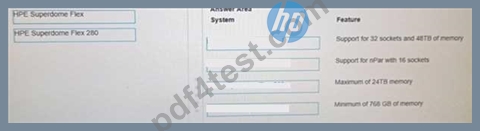
Answer:
Explanation: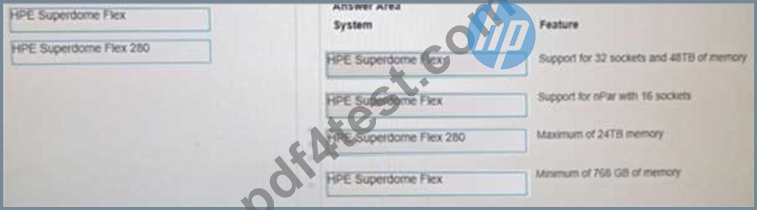
NEW QUESTION # 77
Your customer is trying to grow a VMware cluster using HPE OneView for VMware vCenter Server. They get an error and cannot proceed.
Which tool should you use to troubleshoot the problem?
- A. HPE OneView for VMware vCenter Server to verify if the server profile template is properly imported and registered.
- B. HPE OneView interface to import an existing cluster using the hypervisor cluster profile functionality.
- C. iLO interface of a given HPE Synergy compute node to verify whether this node is registered within HPE OneView.
- D. vCenter Server to use the HPE OneView for VMware vCenter plugin to import the cluster for HPE OneView management.
Answer: A
NEW QUESTION # 78
Click the area within the iLO management interface that will allow you to access workload Advisor.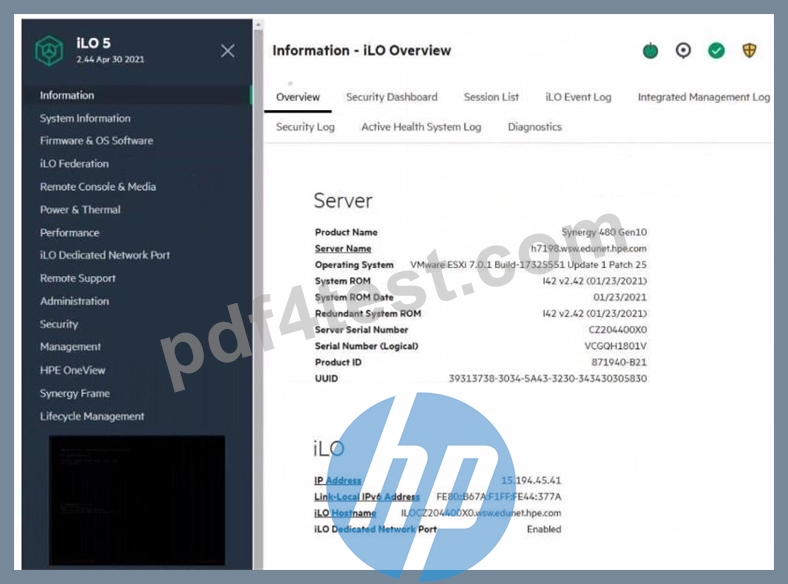
Answer:
Explanation: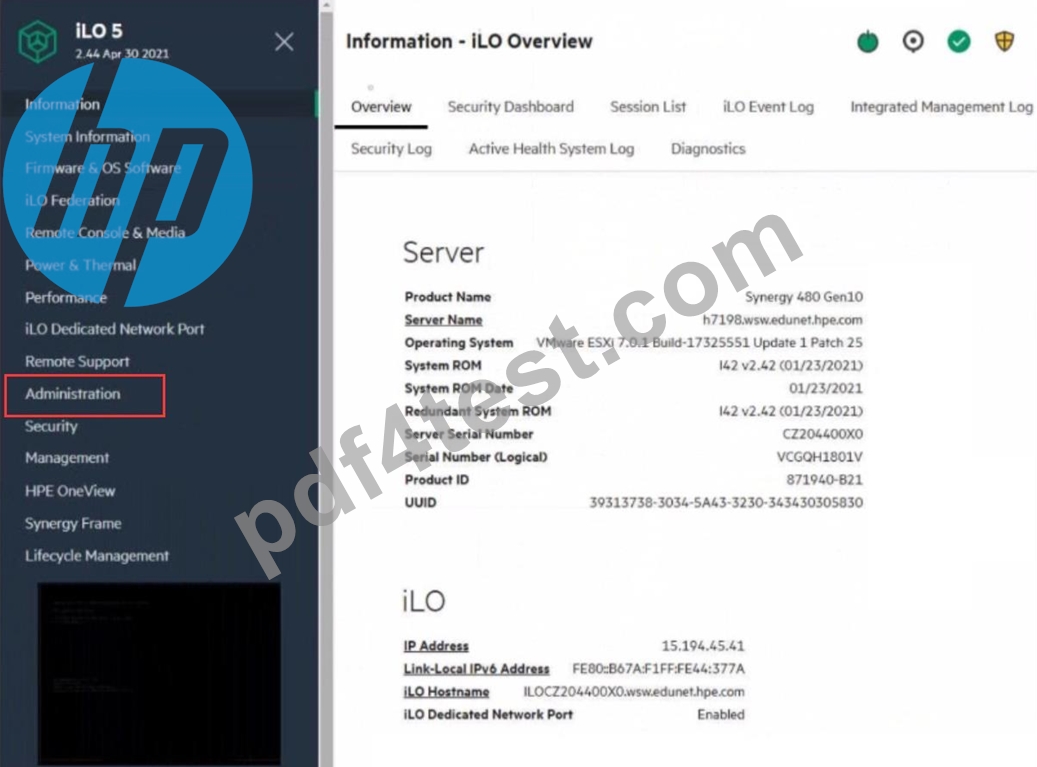
NEW QUESTION # 79
Your customer plans to deploy VMware vSAN using D3940 Storage Modules.
Which statement about this solution is true?
- A. For VMware vSAN deployment, all drives in the D3940 storage modules must be SSD drives.
- B. All drives in the D3940 storage modules must formulate a single logical drive with RAID5 configured
- C. The 12Gb SAS modules required for D3940 connectivity can only be installed in the first fabric.
- D. To use the storage controller that will access D3940 storage modules, a second CPU must be installed.
Answer: A
Explanation:
For VMware vSAN deployments, it is recommended that all drives in the D3940 storage modules be SSD drives to ensure optimal performance and efficiency. SSDs provide the necessary speed and reliability required by vSAN for handling storage-intensive operations and maintaining high performance.
NEW QUESTION # 80
What is important to consider when setting up RAID configurations in an HPE server?
- A. The color scheme of RAID controllers
- B. The visual arrangement of RAID arrays
- C. The RAID level's suitability for the data requirement
- D. Matching RAID controllers with server brands
Answer: C
NEW QUESTION # 81
After deploying HPE Superdome Flex 280 you need to check Core Analysis Engine (CAE) Log.
Click the appropriate section in the HPE Superdome Flex 280 management interface that will allow you to complete this task.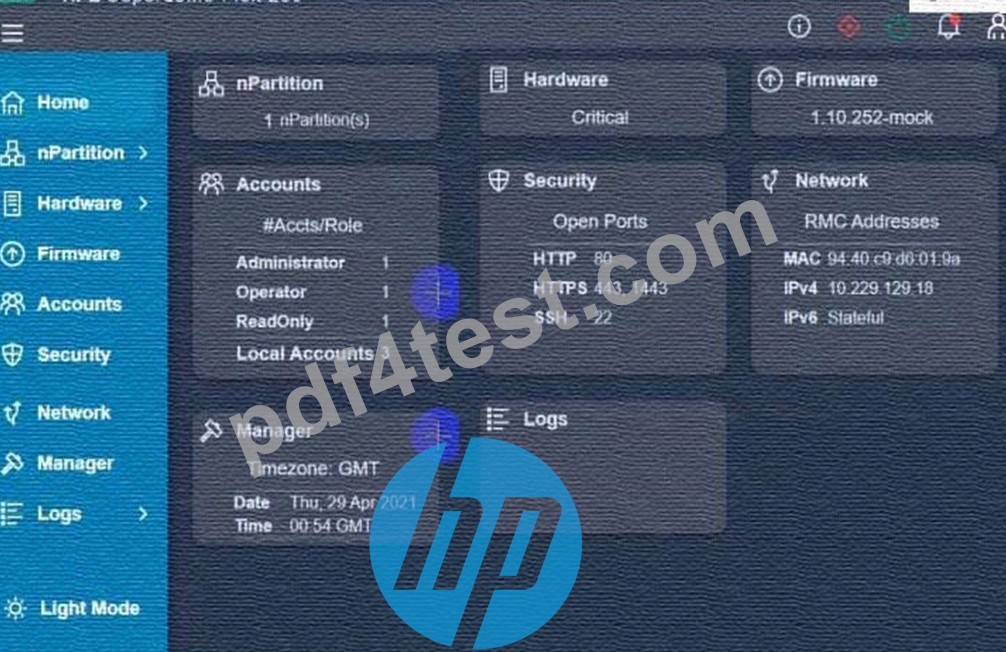
Answer:
Explanation: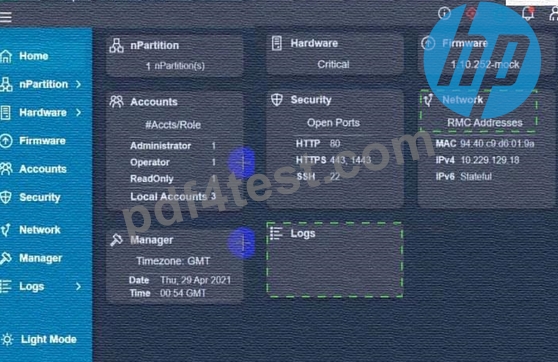
Explanation:
To check the Core Analysis Engine (CAE) Log on the HPE Superdome Flex 280, navigate to the Logs section in the management interface. This section provides access to various logs, including system, security, and diagnostic logs, which encompass the CAE logs necessary for detailed analysis and troubleshooting.
NEW QUESTION # 82
Click the area within the iLO management interface that will allow you to access workload Advisor.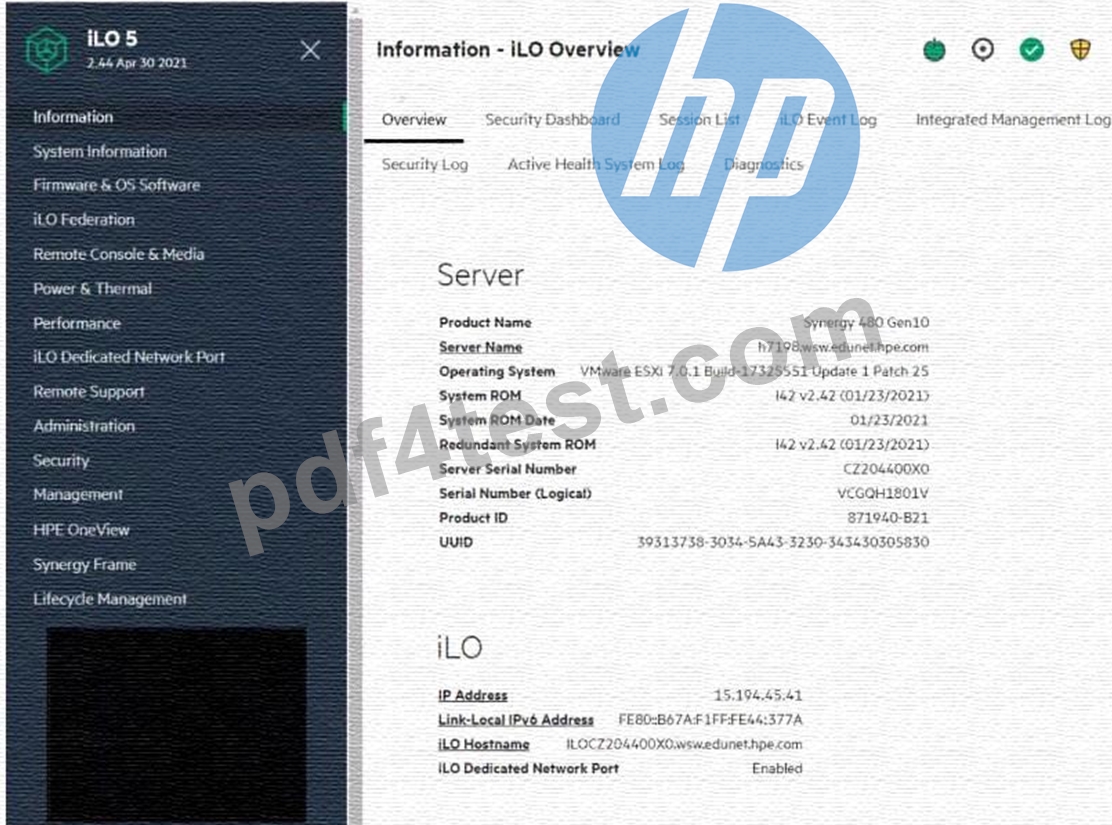
Answer:
Explanation: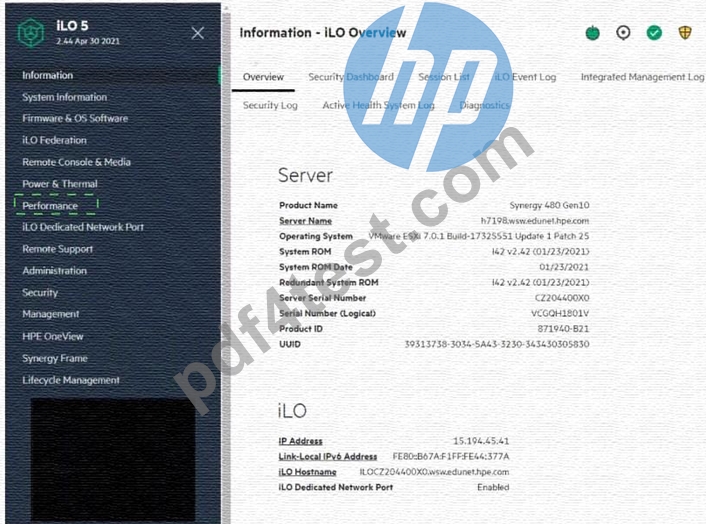
Explanation:
ThePerformancesection within the iLO management interface provides access to the Workload Advisor. This feature offers insights and analytics regarding the server's performance, helping to optimize workloads and manage resources efficiently.
NEW QUESTION # 83
You need to setup HPE Synergy frames after hardware components are discovered within HPE OneView.
Put the steps to achieve this goal into the coned order in the answer area on the right.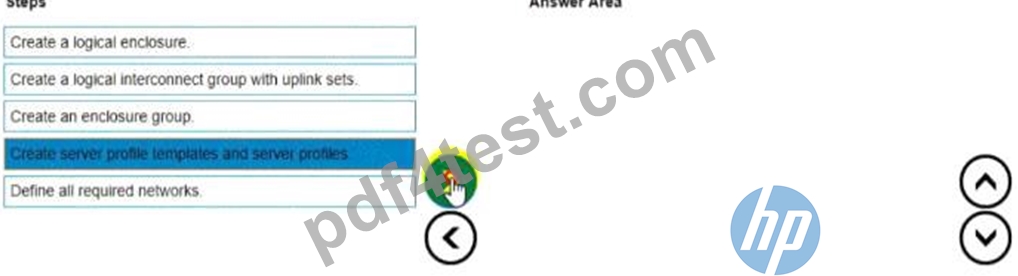
Answer:
Explanation: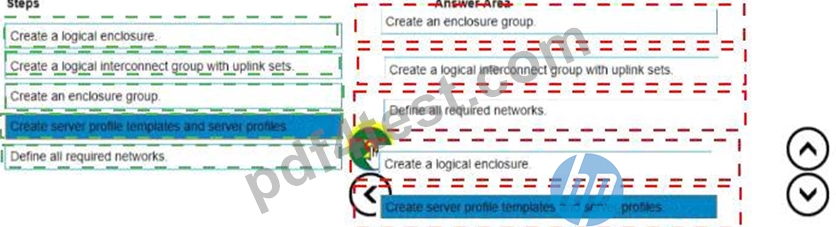
Explanation:
To set up HPE Synergy frames after the hardware components are discovered within HPE OneView, the following steps should be followed in the correct order:
* Create an enclosure group.
* Create a logical interconnect group with uplink sets.
* Define all required networks.
* Create a logical enclosure.
* Create server profile templates and server profiles.
* Create an enclosure group: This step involves defining the enclosure group, which includes the configurations for the enclosure such as firmware baselines and logical interconnect groups.
* Create a logical interconnect group with uplink sets: Next, set up the logical interconnect group, which includes the uplink sets that define the connectivity from the enclosures to the data center networks.
* Define all required networks: After setting up the logical interconnect group, define all the necessary networks that will be used within the HPE Synergy environment.
* Create a logical enclosure: Create a logical enclosure by combining the physical enclosures with the defined enclosure group, effectively binding the hardware configuration with the logical settings.
* Create server profile templates and server profiles: Finally, create server profile templates and individual server profiles to apply the required configuration settings to the compute modules.
NEW QUESTION # 84
Your customer reports that they cannot deploy HPE Synergy compute nodes using HPE OneView for VMware vCenter Server (HPE OV4VC).
What should you check during troubleshooting process?
- A. If vCenter Server is licensed in the HPE Oneview interface
- B. If the HPE Oneview instance Is integrated with HPE OV4VC.
- C. If an compute nodes are added to the vCenter Server
- D. If HPE OneView credentials are added in vCenter Server
Answer: D
Explanation:
When troubleshooting the deployment of HPE Synergy compute nodes using HPE OneView for VMware vCenter Server (HPE OV4VC), it's essential to verify that HPE OneView credentials are correctly added in the vCenter Server. Proper integration and authentication are necessary for HPE OV4VC to communicate and manage the compute nodes effectively.
NEW QUESTION # 85
Your customer wants to add a second HPE Synergy frame to an existing logical enclosure Based on a single HPE Synergy frame. The customer wants to use a highly available master setup.
Which procedures should De performed during the expansion process? (Select two.)
- A. Re-parent an existing enclosure group to the new logical interconnect group.
- B. Modify an existing logical interconnect to include second HPE Synergy frame.
- C. Create a new logical enclosure based on both HPE Synergy frames.
- D. Move one of the master modules to the appropriate interconnect bay in the second frame.
- E. Create a new logical interconnect group and enclosure group for two frames setup
Answer: B,C
NEW QUESTION # 86
Match HPE SimpliVity team with the definition.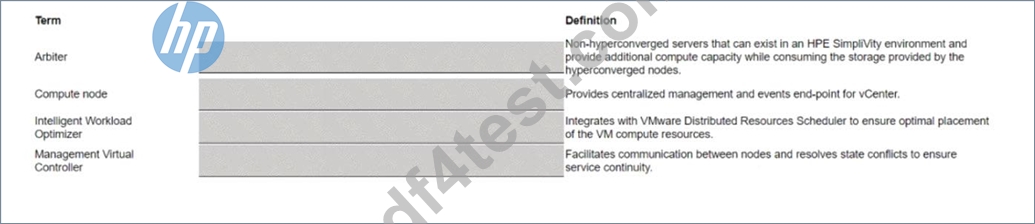
Answer:
Explanation: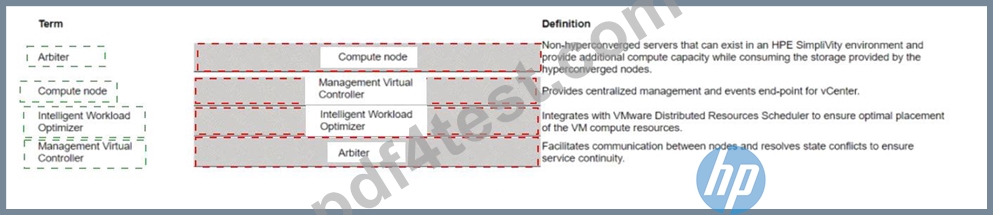
Explanation:
Here are the correct matches for each HPE SimpliVity term with their respective definitions:
* Arbiter Definition: Facilitates communication between nodes and resolves state conflicts to ensure service continuity.
* Compute node Definition: Non-hyperconverged servers that can exist in an HPE SimpliVity environment and provide additional compute capacity while consuming the storage provided by the hyperconverged nodes.
* Intelligent Workload Optimizer Definition: Integrates with VMware Distributed Resources Scheduler to ensure optimal placement of the VM compute resources.
* Management Virtual Controller Definition: Provides centralized management and events end-point for vCenter.
* Arbiter: The Arbiter in an HPE SimpliVity environment is responsible for ensuring communication between nodes and resolving any state conflicts, which is crucial for maintaining service continuity.
* Compute node: In an HPE SimpliVity environment, a compute node refers to non-hyperconverged servers that provide additional compute capacity while utilizing the storage from hyperconverged nodes.
* Intelligent Workload Optimizer: This component integrates with VMware's Distributed Resources Scheduler (DRS) to optimize the placement of virtual machine (VM) compute resources, ensuring they are efficiently distributed across the environment.
* Management Virtual Controller: This controller provides centralized management and serves as the events end-point for vCenter, allowing for streamlined management and monitoring of the SimpliVity environment.
NEW QUESTION # 87
......
Authentic HPE0-S59 Exam Dumps PDF - Sep-2025 Updated: https://validtorrent.pdf4test.com/HPE0-S59-actual-dumps.html
