

Real Real Estate New-Jersey-Real-Estate-Salesperson Exam Dumps with Correct 122 Questions and Answers
Valid New-Jersey-Real-Estate-Salesperson Test Answers & Real Estate New-Jersey-Real-Estate-Salesperson Exam PDF
NEW QUESTION # 63
Rules for Truth in Lending and RESPA call for disclosure documents to borrowers. How can a managing broker best prepare associated licensees to manage these disclosures?
- A. The buyer's broker can provide samples so that when the licensee and the borrower prepare the forms they are following a good example.
- B. Because the listing broker will be primarily responsible for completing the Loan Estimate to send to the lender, the broker should train associated licensees to collect all the necessary information in a timely fashion.
- C. Because the lender has primary responsibility to provide these forms, the broker and licensees should be aware of the items required for the lender to comply.
- D. The managing broker should train licensees to advise borrowers to accept the Loan Estimate right away.
Answer: C
Explanation:
Under TILA-RESPA Integrated Disclosure (TRID) rules, the lender is primarily responsible for preparing and delivering the Loan Estimate and Closing Disclosure.
Brokers and licensees do not prepare these forms.
However, licensees must be knowledgeable about the disclosures so they can help clients understand the process and provide necessary information for lender compliance.
Thus, the best practice is B: brokers should ensure licensees are aware of what the lender requires.
Reference: Truth in Lending Act (Regulation Z); RESPA (Regulation X); NJ Real Estate Salesperson Study Guide, Chapter on Federal Lending Laws.
NEW QUESTION # 64
A contract of sale prepared by a licensee MUST include an attorney review clause if it pertains to which of the following types of properties?
- A. Six-family dwelling unit, a portion of which is used for non-residential purposes
- B. Single family residential vacant lot
- C. Subdivision of fifteen or more lots
- D. Commercial building that does not exceed 10,000 square feet
Answer: B
Explanation:
According to the New Jersey Supreme Court Mandated Attorney Review Clause (as adopted by NJREC, N.J.
A).C. 11:5-6.2(g)), all contracts prepared by licensees for the sale of one-to-four family residential properties and residential vacant lots must contain the three-day attorney review clause.
The purpose is to protect consumers in residential transactions by giving them the right to have their attorney review and potentially cancel or modify the contract within three business days.
Therefore, the correct answer is D, because the attorney review clause is mandatory for contracts involving a single-family residential vacant lot.
Reference: NJREC Rules and Regulations, N.J.A.C. 11:5-6.2(g); NJ Attorney Review Clause Requirement, New Jersey Real Estate Salesperson Pre-Licensure Course Guide.
NEW QUESTION # 65
A buyer who is purchasing a property intends to build a chain link fence in the backyard. There is a 12-year- old deed restriction that prohibits chain link fences. The licensee finds out that there are no city codes prohibiting chain link fences. Which of the following statements regarding this situation is true?
- A. This city code takes priority because deed restrictions expire 10 years after a subdivision is developed.
- B. City code always takes priority over deed restrictions.
- C. Deed restrictions always take priority over city codes.
- D. This deed restriction is more restrictive and will, therefore, take precedence.
Answer: D
Explanation:
Deed restrictions (restrictive covenants) are private controls that can impose stricter requirements than local zoning or codes.
The general rule: the more restrictive regulation prevails (whether deed restriction or zoning).
Deed restrictions do not automatically expire after 10 years unless the restriction itself specifies an expiration.
Since zoning allows fences but the deed restriction prohibits chain link fences, the restriction takes precedence.
Correct answer = D.
Reference: NJ Real Estate Salesperson Study Guide, Chapter on Land Use, Zoning, and Private Restrictions.
NEW QUESTION # 66
A purchase money note need NOT contain the:
- A. rate of interest.
- B. time and method of payment.
- C. principal amount of the loan.
- D. loan-to-value ratio.
Answer: D
Explanation:
A promissory note (purchase money note) is the borrower's written promise to repay a loan. It must include:
The principal amount of the loan.
The interest rate.
The time and method of repayment.
The loan-to-value ratio (LTV) is a lender's underwriting guideline but is not a required element of the promissory note.
Correct answer = C.
Reference: NJ Real Estate Salesperson Study Guide, Chapter on Financing Instruments (Promissory Notes & Mortgages)
NEW QUESTION # 67
A salesperson is convicted of a crime which involved activities as a real estate licensee. The Commission obtains a certified copy of the judgment of conviction against the salesperson. According to the New Jersey Real Estate License Law, the Commission MUST:
- A. revoke the salesperson's license
- B. notify the salesperson's employing broker of the circumstances pertaining to the conviction
- C. determine, at its discretion, what disciplinary action to take against the salesperson
- D. suspend the salesperson's license
Answer: C
Explanation:
Under N.J.S.A. 45:15-17, the New Jersey Real Estate Commission (NJREC) has discretionary authority to determine appropriate disciplinary action when a licensee is convicted of a crime related to their licensed activities.
The Commission may choose to suspend, revoke, or otherwise discipline the licensee depending on circumstances.
It is not automatic that the license must be revoked or suspended; the Commission evaluates the case.
Correct answer = C.
Reference: NJ Real Estate Licensing Law, N.J.S.A. 45:15-17; NJ Real Estate Salesperson Study Guide, Chapter on Disciplinary Actions.
NEW QUESTION # 68
The following statement was found in a real estate sales contract: "In the event of a default by the purchaser, the forfeiture of the earnest money to the seller will be the only compensation to which the seller will be entitled." This statement most likely describes a:
- A. indemnification clause
- B. broker protection clause
- C. liquidated damages clause
- D. default delivery clause
Answer: C
Explanation:
A liquidated damages clause specifies in advance the amount of money or type of damages one party will receive if the other party defaults.
In this case, the earnest money deposit forfeiture is the seller's only compensation in the event of buyer default.
A broker protection clause protects a broker's commission rights.
Indemnification clauses shift liability to another party.
A default delivery clause is not a standard real estate term.
Thus, the correct clause is B: liquidated damages clause.
Reference: NJ Real Estate Salesperson Study Guide, Chapter on Contracts and Contract Clauses.
NEW QUESTION # 69
If an owner wants to list a property for sale "as is," the listing agent should:
- A. assume that the house is a "fixer-upper."
- B. assume that the owner will accept a relatively low price for the property.
- C. question the seller as to any known defects.
- D. conclude that if the buyer later discovers defects that were not disclosed the listing agent is relieved of any responsibility.
Answer: C
Explanation:
"As is" does not relieve a seller or listing agent from disclosure obligations.
The licensee must still make reasonable inquiries about known defects.
All material facts must be disclosed, regardless of the "as is" designation.
"As is" simply means the seller will not make repairs or improvements.
Thus, the agent must ask the seller about known defects = C.
Reference: NJREC Rules and Regulations on Disclosure; NJ Real Estate Salesperson Study Guide, Chapter on Seller Disclosures and "As Is" Sales.
NEW QUESTION # 70
A ranch house with a double garage is being valued. The house next door, which is similar except that it lacks a garage and has an outside deck, was sold last month for $138,000. Experience in that area shows that a two- car garage is probably worth $10,000 to buyers, while in general, they will pay only $500 extra for a deck.
The ranch house is most likely to sell for around:
- A. $128,500
- B. $123,500
- C. $148,500
- D. $147,500
Answer: D
Explanation: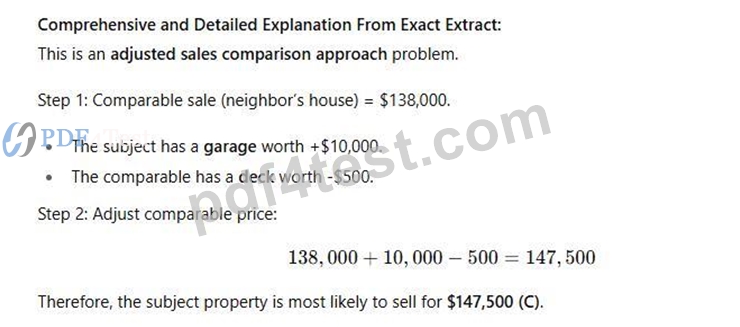
Therefore, the subject property is most likely to sell for $147,500 (C).
Reference: NJ Real Estate Salesperson Study Guide, Chapter on Appraisal Methods (Sales Comparison Approach).
NEW QUESTION # 71
A listing agent presents a signed offer to a seller who then changes the amount of the down payment. Before presenting the counteroffer to the buyer, the New Jersey Real Estate License Law requires the listing agent to
- A. obtain the consent of the listing broker.
- B. verbally inform any buyer's agent of the proposed revision.
- C. secure the seller's initials confirming the revision.
- D. prepare a separate addendum that reflects the revision.
Answer: C
Explanation:
Under NJ Real Estate License Law and Commission regulations (NJAC 11:5-6.2), all material changes to a written offer must be acknowledged in writing by the party making the change before it can be treated as a counteroffer. This is typically done by having the seller initial and date the change on the offer form. Without the seller's written confirmation (initials), the revision is not valid or binding.
A is unnecessary; broker consent is not required for counteroffers.
C is not required unless the parties specifically use an addendum, but initials are the minimum legal requirement.
D is insufficient; oral notice is not valid without written confirmation.
Therefore, the correct answer is B.
(Reference: NJ Real Estate Salesperson Pre-Licensure Course Study Guide, Contracts & License Law- Handling Offers and Counteroffers; NJAC 11:5-6.2.)
NEW QUESTION # 72
As required by the New Jersey Real Estate Sales Full Disclosure Act, before signing any contract for the purchase or lease of a property registered with the New Jersey Real Estate Commission, the purchaser or lessee MUST be provided with a copy of the:
- A. New Jersey Public Offering Statement approved by the Commission
- B. filed plat map identifying the location of the property being bought or leased
- C. Statement of Record filed by the developer with the Commission
- D. deed or other instrument establishing title in the name of the developer
Answer: A
Explanation:
The New Jersey Real Estate Sales Full Disclosure Act (RESFDA) requires developers of certain subdivided land, condominiums, and other registered developments to provide purchasers or lessees with a Public Offering Statement approved by the New Jersey Real Estate Commission.
This Public Offering Statement contains essential information about the development, financial and legal obligations, and rights of buyers.
The Statement of Record is filed with the Commission but is not delivered to the purchaser.
Deeds or plat maps are not substitutes for the disclosure document required by law.
Thus, the correct answer is B.
Reference: N.J.S.A. 45:15-16.27 et seq., New Jersey Real Estate Sales Full Disclosure Act; NJ Real Estate Salesperson Study Guide, Chapter on Land Sales.
NEW QUESTION # 73
A landlord may require that a disabled tenant
- A. pay an additional fee for using the swimming pool to cover the added insurance cost.
- B. not install grab bars in the tile shower if drilling holes in the tile is required.
- C. pay double the usual $500 security deposit.
- D. remove the wheelchair ramp from the apartment upon vacating the unit.
Answer: D
Explanation:
Under the Federal Fair Housing Act (as applied in New Jersey), landlords must permit disabled tenants to make reasonable modifications to the premises at the tenant's expense, such as installing ramps or grab bars.
However:
The landlord cannot charge additional fees (answers A and B are discriminatory).
The landlord cannot prohibit installation of necessary accessibility aids (answer D is illegal).
The landlord can require the tenant to restore the property to its original condition upon vacating, which includes removing modifications such as ramps if they were installed.
Therefore, the correct answer is C.
Reference: NJ Real Estate Salesperson Pre-Licensure Course Guide, Chapter on Fair Housing; Federal Fair Housing Act, Title VIII.
NEW QUESTION # 74
Salesperson P leaves the employ of Broker A. One of the listings at Broker A's firm has agreed to list with Salesperson P at the new firm. In this instance the listing file:
- A. should be given to the seller.
- B. cannot be taken because it belongs to Broker A.
- C. can be taken to the new firm so there is no interruption of service to the client.
- D. should be turned into the MLS.
Answer: B
Explanation:
All listings are taken in the name of the broker, not the salesperson.
When a salesperson leaves a brokerage, the listing remains the property of the broker.
The client may choose to cancel the listing and re-list with the new broker, but the listing file cannot be taken by the departing salesperson.
Correct answer = B.
Reference: NJREC Rules and Regulations; NJ Real Estate Salesperson Study Guide, Chapter on Brokerage Operations.
NEW QUESTION # 75
A seller places a property on the market for sale at a certain price. A buyer sees the property and makes a written offer to purchase that is 90% of the asking price. The seller rejects that offer, but will accept an offer of 95% of the original asking price. The buyer rejects that counteroffer. The original offer is:
- A. irrevocable
- B. rescinded
- C. null and void
- D. binding
Answer: C
Explanation:
Once an offer is rejected or countered, the original offer is terminated and cannot be revived unless resubmitted.
A counteroffer legally cancels the original offer.
Therefore, the buyer's initial offer is null and void once the seller counters.
Correct answer = B.
Reference: NJ Real Estate Salesperson Study Guide, Chapter on Contracts and Offers.
NEW QUESTION # 76
A buyer-broker locates a property that is listed with another broker. The buyer makes an offer through the buyer-broker and an agreement of sale results. In this situation, the buyer-broker is acting as a:
- A. referring broker with the listing broker
- B. representative of the buyer and owes no fiduciary obligations to the seller
- C. subagent of the listing broker
- D. representative of the seller and owes no fiduciary obligations to the buyer
Answer: B
Explanation:
In a buyer agency relationship, the buyer-broker owes fiduciary duties solely to the buyer.
The buyer-broker is not a subagent of the seller's broker unless that is specifically created (rare in NJ).
The buyer-broker represents the buyer, not the seller, and has no fiduciary duty to the seller.
Correct answer = C.
Reference: NJ Real Estate Salesperson Study Guide, Chapter on Buyer Agency and Fiduciary Duties.
NEW QUESTION # 77
The main purpose of a deed is to
- A. provide documentation of legal possession.
- B. convey title.
- C. guarantee clear title.
- D. record and acknowledge title transfer.
Answer: B
Explanation:
Per the Property Ownership & Transfer section of the NJ Real Estate Salesperson Study Guide, the primary purpose of a deed is to transfer ownership (title) from the grantor to the grantee.
* A deed does not guarantee clear title (that would require a warranty or title insurance).
* A deed is not proof of possession; possession may occur without ownership.
* Recording and acknowledgment serve notice, but the deed's legal function is the act of conveyance.
Therefore, the correct answer is A: convey title.
(Reference: NJ Real Estate Salesperson Pre-Licensure Course Study Guide, Transfer of Title-Deeds.) D). verbally inform any buyer's agent of the proposed revision.
NJ Real Estate Agent said:
NEW QUESTION # 78
The common area of a condominium development is owned by:
- A. its duly elected Board of Directors.
- B. all owners as tenants in common.
- C. those owners who were original owners of the units.
- D. any individuals who pay a prorated share of the taxes and maintenance.
Answer: B
Explanation:
In a condominium, each unit owner owns their unit in fee simple.
All common areas (hallways, grounds, recreational areas) are owned by all unit owners collectively as tenants in common, with each owner's interest proportional to their ownership share.
The Board of Directors manages, but does not own, the common areas.
Correct answer = D.
Reference: NJ Condominium Act, N.J.S.A. 46:8B-1 et seq.; NJ Real Estate Salesperson Study Guide, Chapter on Common Interest Properties.
NEW QUESTION # 79
A married couple is planning to purchase a house that costs $86,000. If they obtain a 60% loan and the lender charges a 2.5% loan origination fee and 0.5 discount points, what is the cost of these expenses?
- A. $1,290
- B. $1,548
- C. $2,150
- D. $2,580
Answer: B
Explanation: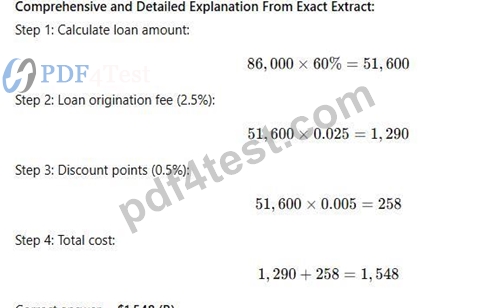
Reference: New Jersey Real Estate Salesperson Pre-Licensure Course Guide, Chapter on Financing and Loan Calculations.
NEW QUESTION # 80
Limiting the neighborhoods in which a licensee shows houses because of a buyer's race is:
- A. puffing
- B. redlining
- C. blockbusting
- D. steering
Answer: D
Explanation:
Steering = Directing or discouraging buyers from certain neighborhoods based on race, religion, or other protected classes. This violates the Federal Fair Housing Act.
Blockbusting = Inducing owners to sell by suggesting a protected class moving into the neighborhood will lower values.
Redlining = Refusing loans or insurance in certain neighborhoods.
Puffing = Exaggerated sales talk, not discriminatory.
Therefore, the action described = steering.
Reference: Federal Fair Housing Act (1968, as amended); NJ Real Estate Salesperson Study Guide, Chapter on Fair Housing Practices.
NEW QUESTION # 81
An appraisal made by a certified appraiser is required:
- A. when heirs receive property.
- B. before real property can transfer from one owner to another.
- C. when the buyer is using an FHA loan to purchase.
- D. before any property settlement in a divorce.
Answer: C
Explanation:
FHA, VA, and other federally-insured loan programs require an appraisal by a certified appraiser before loan approval.
Property transfers, inheritances, or divorces may involve appraisals, but they are not mandated by law in the same way FHA loans require.
Correct answer = C.
Reference: HUD/FHA Loan Guidelines; NJ Real Estate Salesperson Study Guide, Chapter on Appraisal and Loan Underwriting.
NEW QUESTION # 82
......
New-Jersey-Real-Estate-Salesperson Exam Questions and Valid PMP Dumps PDF: https://validtorrent.pdf4test.com/New-Jersey-Real-Estate-Salesperson-actual-dumps.html
