

Pass Data-Engineer-Associate Exam in First Attempt Guaranteed 2026 Dumps!
Data-Engineer-Associate Dumps Full Questions - Exam Study Guide
NEW QUESTION # 37
A company uses AWS Glue jobs to implement several data pipelines. The pipelines are critical to the company.
The company needs to implement a monitoring mechanism that will alert stakeholders if the pipelines fail.
Which solution will meet these requirements with the LEAST operational overhead?
- A. Create an Amazon EventBridge rule to match AWS Glue job failure events. Define an Amazon CloudWatch metric based on the EventBridge rule. Set up a CloudWatch alarm based on the metric to send notifications to an Amazon Simple Notification Service (Amazon SNS) topic.
- B. Create an Amazon EventBridge rule to match AWS Glue job failure events. Configure the rule to target an AWS Lambda function to process events. Configure the function to send notifications to an Amazon Simple Notification Service (Amazon SNS) topic.
- C. Configure an Amazon CloudWatch Logs log group for the AWS Glue jobs. Create an Amazon EventBridge rule to match new log creation events in the log group. Configure the rule to send notifications to an Amazon Simple Notification Service (Amazon SNS) topic.
- D. Configure an Amazon CloudWatch Logs log group for the AWS Glue jobs. Create an Amazon EventBridge rule to match new log creation events in the log group. Configure the rule to target an AWS Lambda function that reads the logs and sends notifications to an Amazon Simple Notification Service (Amazon SNS) topic if AWS Glue job failure logs are present.
Answer: B
NEW QUESTION # 38
A company uses an on-premises Microsoft SQL Server database to store financial transaction data. The company migrates the transaction data from the on-premises database to AWS at the end of each month. The company has noticed that the cost to migrate data from the on-premises database to an Amazon RDS for SQL Server database has increased recently.
The company requires a cost-effective solution to migrate the data to AWS. The solution must cause minimal downtown for the applications that access the database.
Which AWS service should the company use to meet these requirements?
- A. AWS DataSync
- B. AWS Direct Connect
- C. AWS Database Migration Service (AWS DMS)
- D. AWS Lambda
Answer: C
Explanation:
AWS Database Migration Service (AWS DMS) is a cloud service that makes it possible to migrate relational databases, data warehouses, NoSQL databases, and other types of data stores to AWS quickly, securely, and with minimal downtime and zero data loss1. AWS DMS supports migration between 20-plus database and analytics engines, such as Microsoft SQL Server to Amazon RDS for SQL Server2. AWS DMS takes overmany of the difficult or tedious tasks involved in a migration project, such as capacity analysis, hardware and software procurement, installation and administration, testing and debugging, and ongoing replication and monitoring1. AWS DMS is a cost-effective solution, as you only pay for the compute resources and additional log storage used during the migration process2. AWS DMS is the best solution for the company to migrate the financial transaction data from the on-premises Microsoft SQL Server database to AWS, as it meets the requirements of minimal downtime, zero data loss, and low cost.
Option A is not the best solution, as AWS Lambda is a serverless compute service that lets you run code without provisioning or managing servers, but it does not provide any built-in features for database migration.
You would have to write your own code to extract, transform, and load the data from the source to the target, which would increase the operational overhead and complexity.
Option C is not the best solution, as AWS Direct Connect is a service that establishes a dedicated network connection from your premises to AWS, but it does not provide any built-in features for database migration.
You would still need to use another service or tool to perform the actual data transfer, which would increase the cost and complexity.
Option D is not the best solution, as AWS DataSync is a service that makes it easy to transfer data between on-premises storage systems and AWS storage services, such as Amazon S3, Amazon EFS, and Amazon FSx for Windows File Server, but it does not support Amazon RDS for SQL Server as a target. You would have to use another service or tool to migrate the data from Amazon S3 to Amazon RDS for SQL Server, which would increase the latency and complexity. References:
Database Migration - AWS Database Migration Service - AWS
What is AWS Database Migration Service?
AWS Database Migration Service Documentation
AWS Certified Data Engineer - Associate DEA-C01 Complete Study Guide
NEW QUESTION # 39
A data engineer uses Amazon Redshift to run resource-intensive analytics processes once every month. Every month, the data engineer creates a new Redshift provisioned cluster. The data engineer deletes the Redshift provisioned cluster after the analytics processes are complete every month. Before the data engineer deletes the cluster each month, the data engineer unloads backup data from the cluster to an Amazon S3 bucket.
The data engineer needs a solution to run the monthly analytics processes that does not require the data engineer to manage the infrastructure manually.
Which solution will meet these requirements with the LEAST operational overhead?
- A. Use the AWS CLI to automatically process the analytics workload.
- B. Use Amazon Redshift Serverless to automatically process the analytics workload.
- C. Use AWS CloudFormation templates to automatically process the analytics workload.
- D. Use Amazon Step Functions to pause the Redshift cluster when the analytics processes are complete and to resume the cluster to run new processes every month.
Answer: B
Explanation:
Amazon Redshift Serverless is a new feature of Amazon Redshift that enables you to run SQL queries on data in Amazon S3 without provisioning or managing any clusters. You can use Amazon Redshift Serverless to automatically process the analytics workload, as it scales up and down the compute resources based on the query demand, and charges you only for the resources consumed. This solution will meet the requirements with the least operational overhead, as it does not require the data engineer to create, delete, pause, or resume any Redshift clusters, or to manage any infrastructure manually. You can use the Amazon Redshift Data API to run queries from the AWS CLI, AWS SDK, or AWS Lambda functions12.
The other options are not optimal for the following reasons:
A: Use Amazon Step Functions to pause the Redshift cluster when the analytics processes are complete and to resume the cluster to run new processes every month. This option is not recommended, as it would still require the data engineer to create and delete a new Redshift provisioned cluster every month, which can incur additional costs and time. Moreover, this option would require the data engineer to use Amazon Step Functions to orchestrate the workflow of pausing and resuming the cluster, which can add complexity and overhead.
C: Use the AWS CLI to automatically process the analytics workload. This option is vague and does not specify how the AWS CLI is used to process the analytics workload. The AWS CLI can be used to run queries on data in Amazon S3 using Amazon Redshift Serverless, Amazon Athena, or Amazon EMR, but each of these services has different features and benefits. Moreover, this option does not address the requirement of not managing the infrastructure manually, as the data engineer may still need to provision and configure some resources, such as Amazon EMR clusters or Amazon Athena workgroups.
D: Use AWS CloudFormation templates to automatically process the analytics workload. This option is also vague and does not specify how AWS CloudFormation templates are used to process the analytics workload. AWS CloudFormation is a service that lets you model and provision AWS resources using templates. You can use AWS CloudFormation templates to create and delete a Redshift provisioned cluster every month, or to create and configure other AWS resources, such as Amazon EMR, Amazon Athena, or Amazon Redshift Serverless. However, this option does not address the requirement of not managing the infrastructure manually, as the data engineer may still need to write and maintain the AWS CloudFormation templates, and to monitor the status and performance of the resources.
References:
1: Amazon Redshift Serverless
2: Amazon Redshift Data API
3: Amazon Step Functions
4: AWS CLI
5: AWS CloudFormation
NEW QUESTION # 40
A media company wants to improve a system that recommends media content to customer based on user behavior and preferences. To improve the recommendation system, the company needs to incorporate insights from third-party datasets into the company's existing analytics platform.
The company wants to minimize the effort and time required to incorporate third-party datasets.
Which solution will meet these requirements with the LEAST operational overhead?
- A. Use API calls to access and integrate third-party datasets from AWS
- B. Use Amazon Kinesis Data Streams to access and integrate third-party datasets from AWS CodeCommit repositories.
- C. Use Amazon Kinesis Data Streams to access and integrate third-party datasets from Amazon Elastic Container Registry (Amazon ECR).
- D. Use API calls to access and integrate third-party datasets from AWS Data Exchange.
Answer: D
Explanation:
AWS Data Exchange is a service that makes it easy to find, subscribe to, and use third-party data in the cloud.
It provides a secure and reliable way to access and integrate data from various sources, such as data providers, public datasets, or AWS services. Using AWS Data Exchange, you can browse and subscribe to data products that suit your needs, and then use API calls or the AWS Management Console to export the data to Amazon S3, where you can use it with your existing analytics platform. This solution minimizes the effort and time required to incorporate third-party datasets, as you do not need to set up and manage data pipelines, storage, or access controls. You also benefit from the data quality and freshness provided by the data providers, who can update their data products as frequently as needed12.
The other options are not optimal for the following reasons:
B. Use API calls to access and integrate third-party datasets from AWS. This option is vague and does not specify which AWS service or feature is used to access and integrate third-party datasets. AWS offers a variety of services and features that can help with data ingestion, processing, and analysis, but not all of them are suitable for the given scenario. For example, AWS Glue is a serverless data integration service that can help you discover, prepare, and combine data from various sources, but it requires you to create and run data extraction, transformation, and loading (ETL) jobs, which can add operational overhead3.
C. Use Amazon Kinesis Data Streams to access and integrate third-party datasets from AWS CodeCommit repositories. This option is not feasible, as AWS CodeCommit is a source control service that hosts secure Git- based repositories, not a data source that can be accessed by Amazon Kinesis Data Streams. Amazon Kinesis Data Streams is a service that enables you to capture, process, and analyze data streams in real time, such as clickstream data, application logs, or IoT telemetry. It does not support accessing and integrating data from AWS CodeCommit repositories, which are meant for storing and managing code, not data .
D. Use Amazon Kinesis Data Streams to access and integrate third-party datasets from Amazon Elastic Container Registry (Amazon ECR). This option is also not feasible, as Amazon ECR is a fully managed container registry service that stores, manages, and deploys container images, not a data source that can be accessed by Amazon Kinesis Data Streams. Amazon Kinesis Data Streams does not support accessing and integrating data from Amazon ECR, which is meant for storing and managing container images, not data .
1: AWS Data Exchange User Guide
2: AWS Data Exchange FAQs
3: AWS Glue Developer Guide
AWS CodeCommit User Guide
Amazon Kinesis Data Streams Developer Guide
Amazon Elastic Container Registry User Guide
Build a Continuous Delivery Pipeline for Your Container Images with Amazon ECR as Source
NEW QUESTION # 41
A company stores CSV files in an Amazon S3 bucket. A data engineer needs to process the data in the CSV files and store the processed data in a new S3 bucket.
The process needs to rename a column, remove specific columns, ignore the second row of each file, create a new column based on the values of the first row of the data, and filter the results by a numeric value of a column.
Which solution will meet these requirements with the LEAST development effort?
- A. Use an AWS Glue workflow to build a set of jobs to crawl and transform the CSV files.
- B. Use AWS Glue DataBrew recipes to read and transform the CSV files.
- C. Use an AWS Glue custom crawler to read and transform the CSV files.
- D. Use AWS Glue Python jobs to read and transform the CSV files.
Answer: B
NEW QUESTION # 42
A company has a production AWS account that runs company workloads. The company's security team created a security AWS account to store and analyze security logs from the production AWS account. The security logs in the production AWS account are stored in Amazon CloudWatch Logs.
The company needs to use Amazon Kinesis Data Streams to deliver the security logs to the security AWS account.
Which solution will meet these requirements?
- A. Create a destination data stream in the production AWS account. In the production AWS account, create an IAM role that has cross-account permissions to Kinesis Data Streams in the security AWS account.
- B. Create a destination data stream in the security AWS account. Create an IAM role and a trust policy to grant CloudWatch Logs the permission to put data into the stream. Create a subscription filter in the production AWS account.
- C. Create a destination data stream in the security AWS account. Create an IAM role and a trust policy to grant CloudWatch Logs the permission to put data into the stream. Create a subscription filter in the security AWS account.
- D. Create a destination data stream in the production AWS account. In the security AWS account, create an IAM role that has cross-account permissions to Kinesis Data Streams in the production AWS account.
Answer: B
Explanation:
Amazon Kinesis Data Streams is a service that enables you to collect, process, and analyze real-time streaming data. You can use Kinesis Data Streams to ingest data from various sources, such as Amazon CloudWatch Logs, and deliver it to different destinations, such as Amazon S3 or Amazon Redshift. To use Kinesis Data Streams to deliver the security logs from the production AWS account to the security AWS account, you need to create a destination data stream in the security AWS account. This data stream will receive the log data from the CloudWatch Logs service in the production AWS account. To enable this cross- account data delivery, you need to create an IAM role and a trust policy in the security AWS account. The IAM role defines the permissions that the CloudWatch Logs service needs to put data into the destination data stream. The trust policy allows the production AWS account to assume the IAM role. Finally, you need to create a subscription filter in the production AWS account. A subscription filter defines the pattern to match log events and the destination to send the matching events. In this case, the destination is the destination data stream in the security AWS account. This solution meets the requirements of using Kinesis Data Streams to deliver the security logs to the security AWS account. The other options are either not possible or not optimal.
You cannot create a destination data stream in the production AWS account, as this would not deliver the data to the security AWS account. You cannot create a subscription filter in the security AWS account, as this would not capture the log events from the production AWS account. References:
* Using Amazon Kinesis Data Streams with Amazon CloudWatch Logs
* AWS Certified Data Engineer - Associate DEA-C01 Complete Study Guide, Chapter 3: Data Ingestion and Transformation, Section 3.3: Amazon Kinesis Data Streams
NEW QUESTION # 43
The company stores a large volume of customer records in Amazon S3. To comply with regulations, the company must be able to access new customer records immediately for the first 30 days after the records are created. The company accesses records that are older than 30 days infrequently.
The company needs to cost-optimize its Amazon S3 storage.
Which solution will meet these requirements MOST cost-effectively?
- A. Use S3 Intelligent-Tiering storage.
- B. Use S3 Standard-Infrequent Access (S3 Standard-IA) storage for all customer records.
- C. Transition records to S3 Glacier Deep Archive storage after 30 days.
- D. Apply a lifecycle policy to transition records to S3 Standard Infrequent-Access (S3 Standard-IA) storage after 30 days.
Answer: D
Explanation:
The most cost-effective solution in this case is to apply a lifecycle policy to transition records to Amazon S3 Standard-IA storage after 30 days. Here's why:
Amazon S3 Lifecycle Policies: Amazon S3 offers lifecycle policies that allow you to automatically transition objects between different storage classes to optimize costs. For data that is frequently accessed in the first 30 days and infrequently accessed after that, transitioning from the S3 Standard storage class to S3 Standard- Infrequent Access (S3 Standard-IA) after 30 days makes the most sense. S3 Standard-IA is designed for data that is accessed less frequently but still needs to be retained, offering lower storage costs than S3 Standard with a retrieval cost for access.
Cost Optimization: S3 Standard-IA offers a lower price per GB than S3 Standard. Since the data will be accessed infrequently after 30 days, using S3 Standard-IA will lower storage costs while still allowing for immediate retrieval when necessary.
Compliance with Regulations: Since the records need to be immediately accessible for the first 30 days, the use of S3 Standard for that period ensures compliance with regulatory requirements. After 30 days, transitioning to S3 Standard-IA continues to meet access requirements for infrequent access while reducing storage costs.
Alternatives Considered:
Option B (S3 Intelligent-Tiering): While S3 Intelligent-Tiering automatically moves data between access tiers based on access patterns, it incurs a small monthly monitoring and automation charge per object. It could be a viable option, but transitioning data to S3 Standard-IA directly would be more cost-effective since the pattern of access is well-known (frequent for 30 days, infrequent thereafter).
Option C (S3 Glacier Deep Archive): Glacier Deep Archive is the lowest-cost storage class, but it is not suitable in this case because the data needs to be accessed immediately within 30 days and on an infrequent basis thereafter. Glacier Deep Archive requires hours for data retrieval, which is not acceptable for infrequent access needs.
Option D (S3 Standard-IA for all records): Using S3 Standard-IA for all records would result in higher costs for the first 30 days, as the data is frequently accessed. S3 Standard-IA incurs retrieval charges, making it less suitable for frequently accessed data.
Amazon S3 Lifecycle Policies
S3 Storage Classes
Cost Management and Data Optimization Using Lifecycle Policies
AWS Data Engineering Documentation
NEW QUESTION # 44
A manufacturing company collects sensor data from its factory floor to monitor and enhance operational efficiency. The company uses Amazon Kinesis Data Streams to publish the data that the sensors collect to a data stream. Then Amazon Kinesis Data Firehose writes the data to an Amazon S3 bucket.
The company needs to display a real-time view of operational efficiency on a large screen in the manufacturing facility.
Which solution will meet these requirements with the LOWEST latency?
- A. Use AWS Glue bookmarks to read sensor data from the S3 bucket in real time. Publish the data to an Amazon Timestream database. Use the Timestream database as a source to create a Grafana dashboard.
- B. Configure the S3 bucket to send a notification to an AWS Lambda function when any new object is created. Use the Lambda function to publish the data to Amazon Aurora. Use Aurora as a source to create an Amazon QuickSight dashboard.
- C. Use Amazon Managed Service for Apache Flink (previously known as Amazon Kinesis Data Analytics) to process the sensor data. Use a connector for Apache Flink to write data to an Amazon Timestream database. Use the Timestream database as a source to create a Grafana dashboard.
- D. Use Amazon Managed Service for Apache Flink (previously known as Amazon Kinesis Data Analytics) to process the sensor data. Create a new Data Firehose delivery stream to publish data directly to an Amazon Timestream database. Use the Timestream database as a source to create an Amazon QuickSight dashboard.
Answer: D
Explanation:
This solution will meet the requirements with the lowest latency because it uses Amazon Managed Service for Apache Flink to process the sensor data in real time and write it to Amazon Timestream, a fast, scalable, and serverless time series database. Amazon Timestream is optimized for storing and analyzing time series data, such as sensor data, and can handle trillions of events per day with millisecond latency. By using Amazon Timestream as a source, you can create an Amazon QuickSight dashboard that displays a real-time view of operational efficiency on a large screen in the manufacturing facility. Amazon QuickSight is a fully managed business intelligence service that can connect to various data sources, including Amazon Timestream, and provide interactive visualizations and insights123.
The other options are not optimal for the following reasons:
* A. Use Amazon Managed Service for Apache Flink (previously known as Amazon Kinesis Data Analytics) to process the sensor data. Use a connector for Apache Flink to write data to an Amazon Timestream database. Use the Timestream database as a source to create a Grafana dashboard. This option is similar to option C, but it uses Grafana instead of Amazon QuickSight to create the dashboard.
Grafana is an open source visualization tool that can also connect to Amazon Timestream, but it requires additional steps to set up and configure, such as deploying a Grafana server on Amazon EC2, installing the Amazon Timestream plugin, and creating an IAM role for Grafana to access Timestream.
These steps can increase the latency and complexity of the solution.
* B. Configure the S3 bucket to send a notification to an AWS Lambda function when any new object is created. Use the Lambda function to publish the data to Amazon Aurora. Use Aurora as a source to create an Amazon QuickSight dashboard. This option is not suitable for displaying a real-time view of operational efficiency, as it introduces unnecessary delays and costs in the data pipeline. First, the sensor data is written to an S3 bucket by Amazon Kinesis Data Firehose, which can have a buffering interval of up to 900 seconds. Then, the S3 bucket sends a notification to a Lambda function, which can incur additional invocation and execution time. Finally, the Lambda function publishes the data to Amazon Aurora, a relational database that is not optimized for time series data and can have higher storage and performance costs than Amazon Timestream .
* D. Use AWS Glue bookmarks to read sensor data from the S3 bucket in real time. Publish the data to an Amazon Timestream database. Use the Timestream database as a source to create a Grafana dashboard.
This option is also not suitable for displaying a real-time view of operational efficiency, as it uses AWS Glue bookmarks to read sensor data from the S3 bucket. AWS Glue bookmarks are a feature that helps AWS Glue jobs and crawlers keep track of the data that has already been processed, so that they can resume from where they left off. However, AWS Glue jobs and crawlers are not designed for real-time data processing, as they can have a minimum frequency of 5 minutes and a variable start-up time.
Moreover, this option also uses Grafana instead of Amazon QuickSight to create the dashboard, which can increase the latency and complexity of the solution .
References:
* 1: Amazon Managed Streaming for Apache Flink
* 2: Amazon Timestream
* 3: Amazon QuickSight
* : Analyze data in Amazon Timestream using Grafana
* : Amazon Kinesis Data Firehose
* : Amazon Aurora
* : AWS Glue Bookmarks
* : AWS Glue Job and Crawler Scheduling
NEW QUESTION # 45
A data engineer uses Amazon Redshift to run resource-intensive analytics processes once every month. Every month, the data engineer creates a new Redshift provisioned cluster. The data engineer deletes the Redshift provisioned cluster after the analytics processes are complete every month. Before the data engineer deletes the cluster each month, the data engineer unloads backup data from the cluster to an Amazon S3 bucket.
The data engineer needs a solution to run the monthly analytics processes that does not require the data engineer to manage the infrastructure manually.
Which solution will meet these requirements with the LEAST operational overhead?
- A. Use the AWS CLI to automatically process the analytics workload.
- B. Use Amazon Redshift Serverless to automatically process the analytics workload.
- C. Use AWS CloudFormation templates to automatically process the analytics workload.
- D. Use Amazon Step Functions to pause the Redshift cluster when the analytics processes are complete and to resume the cluster to run new processes every month.
Answer: B
Explanation:
Amazon Redshift Serverless is a new feature of Amazon Redshift that enables you to run SQL queries on data in Amazon S3 without provisioning or managing any clusters. You can use Amazon Redshift Serverless to automatically process the analytics workload, as it scales up and down the compute resources based on the query demand, and charges you only for the resources consumed. This solution will meet the requirements with the least operational overhead, as it does not require the data engineer to create, delete, pause, or resume any Redshift clusters, or to manage any infrastructure manually. You can use the Amazon Redshift Data API to run queries from the AWS CLI, AWS SDK, or AWS Lambda functions12.
The other options are not optimal for the following reasons:
A. Use Amazon Step Functions to pause the Redshift cluster when the analytics processes are complete and to resume the cluster to run new processes every month. This option is not recommended, as it would still require the data engineer to create and delete a new Redshift provisioned cluster every month, which can incur additional costs and time. Moreover, this option would require the data engineer to use Amazon Step Functions to orchestrate the workflow of pausing and resuming the cluster, which can add complexity and overhead.
C. Use the AWS CLI to automatically process the analytics workload. This option is vague and does not specify how the AWS CLI is used to process the analytics workload. The AWS CLI can be used to run queries on data in Amazon S3 using Amazon Redshift Serverless, Amazon Athena, or Amazon EMR, but each of these services has different features and benefits. Moreover, this option does not address the requirement of not managing the infrastructure manually, as the data engineer may still need to provision and configure some resources, such as Amazon EMR clusters or Amazon Athena workgroups.
D. Use AWS CloudFormation templates to automatically process the analytics workload. This option is also vague and does not specify how AWS CloudFormation templates are used to process the analytics workload.
AWS CloudFormation is a service that lets you model and provision AWS resources using templates. You can use AWS CloudFormation templates to create and delete a Redshift provisioned cluster every month, or to create and configure other AWS resources, such as Amazon EMR, Amazon Athena, or Amazon Redshift Serverless. However, this option does not address the requirement of not managing the infrastructure manually, as the data engineer may still need to write and maintain the AWS CloudFormation templates, and to monitor the status and performance of the resources.
1: Amazon Redshift Serverless
2: Amazon Redshift Data API
Amazon Step Functions
AWS CLI
AWS CloudFormation
NEW QUESTION # 46
A company uses Amazon S3 to store semi-structured data in a transactional data lake. Some of the data files are small, but other data files are tens of terabytes.
A data engineer must perform a change data capture (CDC) operation to identify changed data from the data source. The data source sends a full snapshot as a JSON file every day and ingests the changed data into the data lake.
Which solution will capture the changed data MOST cost-effectively?
- A. Ingest the data into Amazon RDS for MySQL. Use AWS Database Migration Service (AWS DMS) to write the changed data to the data lake.
- B. Use an open source data lake format to merge the data source with the S3 data lake to insert the new data and update the existing data.
- C. Ingest the data into an Amazon Aurora MySQL DB instance that runs Aurora Serverless. Use AWS Database Migration Service (AWS DMS) to write the changed data to the data lake.
- D. Create an AWS Lambda function to identify the changes between the previous data and the current data. Configure the Lambda function to ingest the changes into the data lake.
Answer: B
Explanation:
An open source data lake format, such as Apache Parquet, Apache ORC, or Delta Lake, is a cost-effective way to perform a change data capture (CDC) operation on semi-structured data stored in Amazon S3. An open source data lake format allows you to query data directly from S3 using standard SQL, without the need to move or copy data to another service. An open source data lake format also supports schema evolution, meaning it can handle changes in the data structure over time. An open source data lake format also supports upserts, meaning it can insert new data and update existing data in the same operation, using a merge command. This way, you can efficiently capture the changes from the data source and apply them to the S3 data lake, without duplicating or losing any data.
The other options are not as cost-effective as using an open source data lake format, as they involve additional steps or costs. Option A requires you to create and maintain an AWS Lambda function, which can be complex and error-prone. AWS Lambda also has some limits on the execution time, memory, and concurrency, which can affect the performance and reliability of the CDC operation. Option B and D require you to ingest the data into a relational database service, such as Amazon RDS or Amazon Aurora, which can be expensive and unnecessary for semi-structured data. AWS Database Migration Service (AWS DMS) can write the changed data to the data lake, but it also charges you for the data replication and transfer. Additionally, AWS DMS does not support JSON as a source data type, so you would need to convert the data to a supported format before using AWS DMS. References:
* What is a data lake?
* Choosing a data format for your data lake
* Using the MERGE INTO command in Delta Lake
* [AWS Lambda quotas]
* [AWS Database Migration Service quotas]
NEW QUESTION # 47
A company wants to analyze sales records that the company stores in a MySQL database. The company wants to correlate the records with sales opportunities identified by Salesforce.
The company receives 2 GB erf sales records every day. The company has 100 GB of identified sales opportunities. A data engineer needs to develop a process that will analyze and correlate sales records and sales opportunities. The process must run once each night.
Which solution will meet these requirements with the LEAST operational overhead?
- A. Use Amazon AppFlow to fetch sales opportunities from Salesforce. Use Amazon Kinesis Data Streams to fetch sales records from the MySQL database. Use Amazon Managed Service for Apache Flink to correlate the datasets. Use AWS Step Functions to orchestrate the process.
- B. Use Amazon Managed Workflows for Apache Airflow (Amazon MWAA) to fetch both datasets. Use AWS Lambda functions to correlate the datasets. Use AWS Step Functions to orchestrate the process.
- C. Use Amazon AppFlow to fetch sales opportunities from Salesforce. Use AWS Glue to fetch sales records from the MySQL database. Correlate the sales records with sales opportunities. Use AWS Step Functions to orchestrate the process.
- D. Use Amazon AppFlow to fetch sales opportunities from Salesforce. Use AWS Glue to fetch sales records from the MySQL database. Correlate the sales records with the sales opportunities. Use Amazon Managed Workflows for Apache Airflow (Amazon MWAA) to orchestrate the process.
Answer: C
Explanation:
* Problem Analysis:
* The company processes 2 GB of daily sales records and 100 GB of Salesforce sales opportunities.
* The goal is to analyze and correlate the two datasets with low operational overhead.
* The process must run once nightly.
* Key Considerations:
* Amazon AppFlow simplifies data integration with Salesforce.
* AWS Glue can extract data from MySQL and perform ETL operations.
* Step Functions can orchestrate workflows with minimal manual intervention.
* Apache Airflow and Flink add complexity, which conflicts with the requirement for low operational overhead.
* Solution Analysis:
* Option A: MWAA + Lambda + Step Functions
* Requires custom Lambda code for dataset correlation, increasing development and operational complexity.
* Option B: AppFlow + Glue + MWAA
* MWAA adds orchestration overhead compared to the simpler Step Functions.
* Option C: AppFlow + Glue + Step Functions
* AppFlow fetches Salesforce data, Glue extracts MySQL data, and Step Functions orchestrate the entire process.
* Minimal setup and operational overhead, making it the best choice.
* Option D: AppFlow + Kinesis + Flink + Step Functions
* Using Kinesis and Flink for batch processing introduces unnecessary complexity.
* Final Recommendation:
* Use Amazon AppFlow to fetch Salesforce data, AWS Glue to process MySQL data, and Step Functions for orchestration.
:
Amazon AppFlow Overview
AWS Glue ETL Documentation
AWS Step Functions
NEW QUESTION # 48
A company has as JSON file that contains personally identifiable information (PIT) data and non-PII data.
The company needs to make the data available for querying and analysis. The non-PII data must be available to everyone in the company. The PII data must be available only to a limited group of employees. Which solution will meet these requirements with the LEAST operational overhead?
- A. Store the JSON file in an Amazon S3 bucket. Catalog the file schema in AWS Lake Formation. Use Lake Formation permissions to provide access to the required data based on the type of user.
- B. Store the JSON file in an Amazon S3 bucket. Configure AWS Glue to split the file into one file that contains the PII data and one file that contains the non-PII data. Store the output files in separate S3 buckets. Grant the required access to the buckets based on the type of user.
- C. Create two Amazon RDS PostgreSQL databases. Load the PII data and the non-PII data into the separate databases. Grant access to the databases based on the type of user.
- D. Store the JSON file in an Amazon S3 bucket. Use Amazon Macie to identify PII data and to grant access based on the type of user.
Answer: A
NEW QUESTION # 49
A manufacturing company collects sensor data from its factory floor to monitor and enhance operational efficiency. The company uses Amazon Kinesis Data Streams to publish the data that the sensors collect to a data stream. Then Amazon Kinesis Data Firehose writes the data to an Amazon S3 bucket.
The company needs to display a real-time view of operational efficiency on a large screen in the manufacturing facility.
Which solution will meet these requirements with the LOWEST latency?
- A. Use AWS Glue bookmarks to read sensor data from the S3 bucket in real time. Publish the data to an Amazon Timestream database. Use the Timestream database as a source to create a Grafana dashboard.
- B. Configure the S3 bucket to send a notification to an AWS Lambda function when any new object is created. Use the Lambda function to publish the data to Amazon Aurora. Use Aurora as a source to create an Amazon QuickSight dashboard.
- C. Use Amazon Managed Service for Apache Flink (previously known as Amazon Kinesis Data Analytics) to process the sensor data. Use a connector for Apache Flink to write data to an Amazon Timestream database. Use the Timestream database as a source to create a Grafana dashboard.
- D. Use Amazon Managed Service for Apache Flink (previously known as Amazon Kinesis Data Analytics) to process the sensor data. Create a new Data Firehose delivery stream to publish data directly to an Amazon Timestream database. Use the Timestream database as a source to create an Amazon QuickSight dashboard.
Answer: D
Explanation:
This solution will meet the requirements with the lowest latency because it uses Amazon Managed Service for Apache Flink to process the sensor data in real time and write it to Amazon Timestream, a fast, scalable, and serverless time series database. Amazon Timestream is optimized for storing and analyzing time series data, such as sensor data, and can handle trillions of events per day with millisecond latency. By using Amazon Timestream as a source, you can create an Amazon QuickSight dashboard that displays a real-time view of operational efficiency on a large screen in the manufacturingfacility. Amazon QuickSight is a fully managed business intelligence service that can connect to various data sources, including Amazon Timestream, and provide interactive visualizations and insights123.
The other options are not optimal for the following reasons:
* A. Use Amazon Managed Service for Apache Flink (previously known as Amazon Kinesis Data Analytics) to process the sensor data. Use a connector for Apache Flink to write data to an Amazon Timestream database. Use the Timestream database as a source to create a Grafana dashboard. This option is similar to option C, but it uses Grafana instead of Amazon QuickSight to create the dashboard.
Grafana is an open source visualization tool that can also connect to Amazon Timestream, but it requires additional steps to set up and configure, such as deploying a Grafana server on Amazon EC2, installing the Amazon Timestream plugin, and creating an IAM role for Grafana to access Timestream.
These steps can increase the latency and complexity of the solution.
* B. Configure the S3 bucket to send a notification to an AWS Lambda function when any new object is created. Use the Lambda function to publish the data to Amazon Aurora. Use Aurora as a source to create an Amazon QuickSight dashboard. This option is not suitable for displaying a real-time view of operational efficiency, as it introduces unnecessary delays and costs in the data pipeline. First, the sensor data is written to an S3 bucket by Amazon Kinesis Data Firehose, which can have a buffering interval of up to 900 seconds. Then, the S3 bucket sends a notification to a Lambda function, which can incur additional invocation and execution time. Finally, the Lambda function publishes the data to Amazon Aurora, a relational database that is not optimized for time series data and can have higher storage and performance costs than Amazon Timestream .
* D. Use AWS Glue bookmarks to read sensor data from the S3 bucket in real time. Publish the data to an Amazon Timestream database. Use the Timestream database as a source to create a Grafana dashboard.
This option is also not suitable for displaying a real-time view of operational efficiency, as it uses AWS Glue bookmarks to read sensor data from the S3 bucket. AWS Glue bookmarks are a feature that helps AWS Glue jobs and crawlers keep track of the data that has already been processed, so that they can resume from where they left off. However, AWS Glue jobs and crawlers are not designed for real-time data processing, as they can have a minimum frequency of 5 minutes and a variable start-up time.
Moreover, this option also uses Grafana instead of Amazon QuickSight to create the dashboard, which can increase the latency and complexity of the solution .
:
1: Amazon Managed Streaming for Apache Flink
2: Amazon Timestream
3: Amazon QuickSight
4: Analyze data in Amazon Timestream using Grafana
5: Amazon Kinesis Data Firehose
6: Amazon Aurora
7: AWS Glue Bookmarks
8: AWS Glue Job and Crawler Scheduling
NEW QUESTION # 50
A company stores employee data in Amazon Redshift A table named Employee uses columns named Region ID, Department ID, and Role ID as a compound sort key. Which queries will MOST increase the speed of a query by using a compound sort key of the table? (Select TWO.)
- A. Select " from Employee where Role ID=50;
- B. Select * from Employee where Region ID='North America' and Role ID=50;
- C. Select * from Employee where Department ID=20 and Region ID='North America';
- D. Select * from Employee where Region ID='North America';
- E. Select * from Employee where Region ID='North America' and Department ID=20;
Answer: C,E
Explanation:
In Amazon Redshift, a compound sort key is designed to optimize the performance of queries that use filtering and join conditions on the columns in the sort key. A compound sort key orders the data based on the first column, followed by the second, and so on. In the scenario given, the compound sort key consists of Region ID, Department ID, and Role ID. Therefore, queries that filter on the leading columns of the sort key are more likely to benefit from this order.
* Option B: "Select * from Employee where Region ID='North America' and Department ID=20;" This query will perform well because it uses both the Region ID and Department ID, which are the first two columns of the compound sort key. The order of the columns in the WHERE clause matches the order in the sort key, thus allowing the query to scan fewer rows and improve performance.
* Option C: "Select * from Employee where Department ID=20 and Region ID='North America';" This query also benefits from the compound sort key because it includes both Region ID and Department ID, which are the first two columns in the sort key. Although the order in the WHERE clause does not match exactly, Amazon Redshift will still leverage the sort key to reduce the amount of data scanned, improving query speed.
* Options A, D, and E are less optimal because they do not utilize the sort key as effectively:
* Option A only filters by the Region ID, which may still use the sort key but does not take full advantage of the compound nature.
* Option D uses only Role ID, the last column in the compound sort key, which will not benefit much from sorting since it is the third key in the sort order.
* Option E filters on Region ID and Role ID but skips the Department ID column, making it less efficient for the compound sort key.
References:
* Amazon Redshift Documentation - Sorting Data
* AWS Certified Data Analytics Study Guide
* AWS Certification - Data Engineer Associate Exam Guide
NEW QUESTION # 51
A data engineer needs to schedule a workflow that runs a set of AWS Glue jobs every day. The data engineer does not require the Glue jobs to run or finish at a specific time.
Which solution will run the Glue jobs in the MOST cost-effective way?
- A. Choose the FLEX execution class in the Glue job properties.
- B. Use the Spot Instance type in Glue job properties.
- C. Choose the latest version in the GlueVersion field in the Glue job properties.
- D. Choose the STANDARD execution class in the Glue job properties.
Answer: A
Explanation:
The FLEX execution class allows you to run AWS Glue jobs on spare compute capacity instead of dedicated hardware. This can reduce the cost of running non-urgent or non-time sensitive data integration workloads, such as testing and one-time data loads. The FLEX execution class is available for AWS Glue 3.0 Spark jobs.
The other options are not as cost-effective as FLEX, because they either use dedicated resources (STANDARD) or do not affect the cost at all (Spot Instance type and GlueVersion). References:
Introducing AWS Glue Flex jobs: Cost savings on ETL workloads
Serverless Data Integration - AWS Glue Pricing
AWS Certified Data Engineer - Associate DEA-C01 Complete Study Guide (Chapter 5, page 125)
NEW QUESTION # 52
A company has a data processing pipeline that runs multiple SQL queries in sequence against an Amazon Redshift cluster. The company merges with a second company. The original company modifies a query that aggregates sales revenue data to join sales tables from both companies.
The sales table for the first company is named Table S1 and contains 10 billion records. The sales table for the second company is named Table S2 and contains 900 million records. The query becomes slow after the modification.
A data engineer must improve the query performance.
Which solutions will meet these requirements? (Select TWO)
- A. Use Amazon Redshift Advisor to review and select optimizations to implement.
- B. Use the KEY distribution style for both sales tables. Select a high-cardinality column to use for the join.
- C. Use the KEY distribution style for both sales tables. Select a low-cardinality column to use for the join.
- D. Use the EVEN distribution style for Table S1. Use the ALL distribution style for Table S2.
- E. Use the Amazon Redshift query optimizer to review and select optimizations to implement.
Answer: A,B
Explanation:
Amazon Redshift query performance for large joins depends heavily on data distribution and query optimization. Using the KEY distribution style on both tables ensures that rows with the same join key are co-located on the same compute nodes, minimizing costly data redistribution during joins.
Selecting a high-cardinality column as the distribution key is critical to evenly distribute data across nodes and prevent data skew. Low-cardinality keys can cause hotspots where too much data resides on a small number of nodes, degrading performance.
Using EVEN distribution on the 10-billion-row table and ALL distribution on the 900-million-row table is inefficient because ALL distribution replicates the entire table to every node, which is not appropriate for large datasets. The Amazon Redshift query optimizer operates automatically and does not require manual selection.
Amazon Redshift Advisor analyzes workload patterns and provides actionable recommendations for distribution styles, sort keys, and query optimizations. Using Redshift Advisor allows the data engineer to apply proven optimizations based on actual cluster usage.
Therefore, combining KEY distribution with a high-cardinality join column and leveraging Amazon Redshift Advisor recommendations is the most effective solution to improve query performance.
NEW QUESTION # 53
A company maintains multiple extract, transform, and load (ETL) workflows that ingest data from the company's operational databases into an Amazon S3 based data lake. The ETL workflows use AWS Glue and Amazon EMR to process data.
The company wants to improve the existing architecture to provide automated orchestration and to require minimal manual effort.
Which solution will meet these requirements with the LEAST operational overhead?
- A. AWS Step Functions tasks
- B. AWS Lambda functions
- C. Amazon Managed Workflows for Apache Airflow (Amazon MWAA) workflows
- D. AWS Glue workflows
Answer: D
Explanation:
AWS Glue workflows are a feature of AWS Glue that enable you to create and visualize complex ETL pipelines using AWS Glue components, such as crawlers, jobs, triggers, and development endpoints. AWS Glue workflows provide automated orchestration and require minimal manual effort, as they handle dependency resolution, error handling, state management, and resource allocation for your ETL workflows.
You can use AWS Glue workflows to ingest data from your operational databases into your Amazon S3 based data lake, and then use AWS Glue and Amazon EMR to process the data in the data lake. This solution will meet the requirements with the least operational overhead, as it leverages the serverless and fully managed nature of AWS Glue, and the scalability and flexibility of Amazon EMR12.
The other options are not optimal for the following reasons:
* B. AWS Step Functions tasks. AWS Step Functions is a service that lets you coordinate multiple AWS services into serverless workflows. You can use AWS Step Functions tasks to invoke AWS Glue and Amazon EMR jobs as part of your ETL workflows, and use AWS Step Functions state machines to define the logic and flow of your workflows. However, this option would require more manual effort than AWS Glue workflows, as you would need to write JSON code to define your state machines, handle errors and retries, and monitor the execution history and status of your workflows3.
* C. AWS Lambda functions. AWS Lambda is a service that lets you run code without provisioning or managing servers. You can use AWS Lambda functions to trigger AWS Glue and Amazon EMR jobs as part of your ETL workflows, and use AWS Lambda event sources and destinations to orchestrate the flow of your workflows. However, this option would also require more manual effort than AWS Glue workflows, as you would need to write code to implement your business logic, handle errors and retries, and monitor the invocation and execution of your Lambda functions. Moreover, AWS Lambda functions have limitations on the execution time, memory, and concurrency, which may affect the performance and scalability of your ETL workflows.
* D. Amazon Managed Workflows for Apache Airflow (Amazon MWAA) workflows. Amazon MWAA is a managed service that makes it easy to run open source Apache Airflow on AWS. Apache Airflow is a popular tool for creating and managing complex ETL pipelines using directed acyclic graphs (DAGs).
You can use Amazon MWAA workflows to orchestrate AWS Glue and Amazon EMR jobs as part of your ETL workflows, and use the Airflow web interface to visualize and monitor your workflows.
However, this option would have more operational overhead than AWS Glue workflows, as you would need to set up and configure your Amazon MWAA environment, write Python code to define your DAGs, and manage the dependencies and versions of your Airflow plugins and operators.
References:
* 1: AWS Glue Workflows
* 2: AWS Glue and Amazon EMR
* 3: AWS Step Functions
* : AWS Lambda
* : Amazon Managed Workflows for Apache Airflow
NEW QUESTION # 54
A data engineer needs to create an Amazon Athena table based on a subset of data from an existing Athena table named cities_world. The cities_world table contains cities that are located around the world. The data engineer must create a new table named cities_us to contain only the cities from cities_world that are located in the US.
Which SQL statement should the data engineer use to meet this requirement?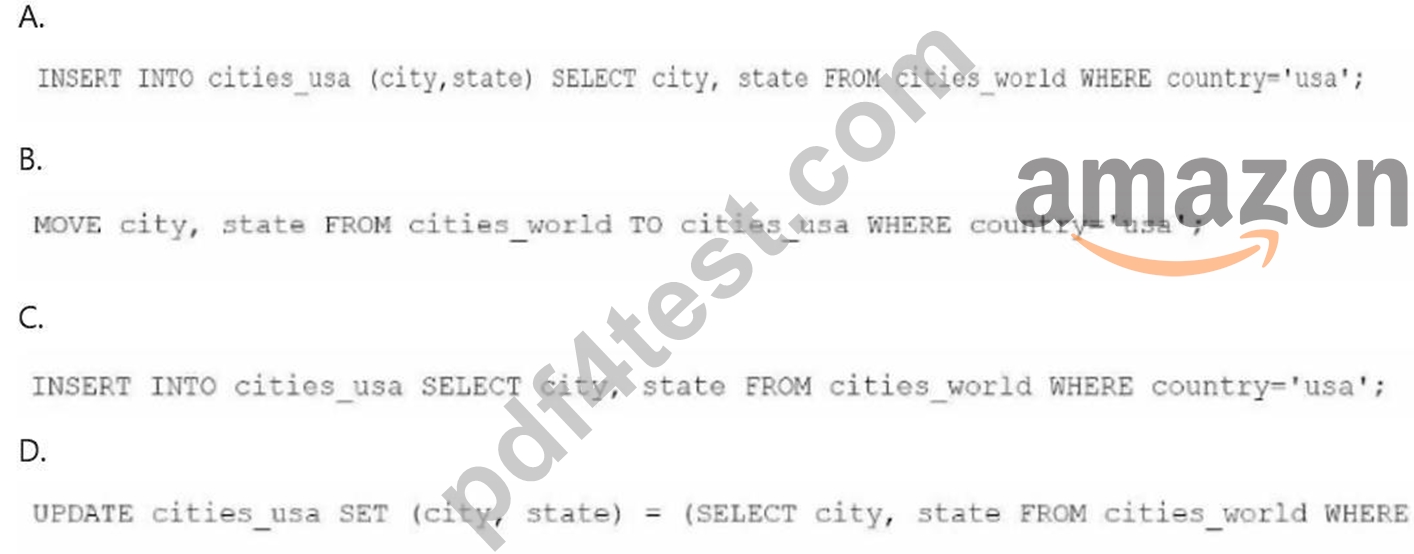
- A. Option B
- B. Option C
- C. Option D
- D. Option A
Answer: D
Explanation:
To create a new table named cities_usa in Amazon Athena based on a subset of data from the existing cities_world table, you should use anINSERT INTOstatement combined with aSELECTstatement to filter only the records where the country is 'usa'. The correct SQL syntax would be:
* Option A: INSERT INTO cities_usa (city, state) SELECT city, state FROM cities_world WHERE country='usa';This statement inserts only the cities and states where the country column has a value of
'usa' from the cities_world table into the cities_usa table. This is a correct approach to create a new table with data filtered from an existing table in Athena.
Options B, C, and Dare incorrect due to syntax errors or incorrect SQL usage (e.g., the MOVE command or the use of UPDATE in a non-relevant context).
References:
Amazon Athena SQL Reference
Creating Tables in Athena
NEW QUESTION # 55
A data engineer needs to make tabular data available in an Amazon S3-based data lake. Users must be able to query the data by using SQL queries in Amazon Redshift, Amazon Athena, and Amazon EMR. The data is updated daily. The data engineer must ensure that updates and deletions are reflected in the data lake.
Which solution will meet these requirements with the LEAST operational overhead?
- A. Create S3 tables for the tabular data. Use AWS Glue and an S3 tables catalog for Apache Iceberg JAR to perform the daily updates and deletions. Configure a compaction size target. Set up snapshot management and unreferenced file removal for the S3 tables bucket.
- B. Load the data into an Amazon Redshift cluster. Use SQL to perform the daily updates and deletions.
Upload the data to an Amazon S3 bucket in Apache Parquet format to create the data lake. - C. Store the data in S3 Standard. Configure Apache Hudi with merge-on-read in Amazon EMR. Use Apache Spark SQL in Amazon EMR to perform the daily updates and deletions. Use Amazon EMR to schedule compaction jobs. Use AWS Glue to create a data catalog of Hudi tables that are stored in Amazon S3.
- D. Load the data into an Amazon EMR cluster. Use Apache Spark to perform the daily updates and deletions. Upload the data into an Amazon S3 bucket in Apache Parquet format to create the data lake.
Answer: A
Explanation:
Comprehensive and Detailed Explanation (150-250 words)
Apache Iceberg is a table format designed for large-scale data lakes that supports ACID transactions, schema evolution, time travel, and row-level updates and deletes. Using S3 Tables with Apache Iceberg provides a fully managed experience that integrates natively with Amazon Athena, Amazon Redshift, and Amazon EMR.
By using AWS Glue with the Iceberg catalog, the data engineer can perform daily updates and deletions without managing Spark clusters, compaction scheduling, or metadata cleanup manually. Iceberg handles snapshots, file pruning, and unreferenced file removal automatically, significantly reducing operational overhead.
Apache Hudi requires Amazon EMR clusters, Spark jobs, and manual compaction orchestration, increasing complexity. The Parquet-only approaches in options C and D do not support updates or deletes efficiently and would require full rewrites of datasets, which is not scalable.
Therefore, using S3 Tables with Apache Iceberg provides the most efficient, scalable, and low-maintenance solution that satisfies all query and update requirements.
NEW QUESTION # 56
A company has used an Amazon Redshift table that is named Orders for 6 months. The company performs weekly updates and deletes on the table. The table has an interleaved sort key on a column that contains AWS Regions.
The company wants to reclaim disk space so that the company will not run out of storage space. The company also wants to analyze the sort key column.
Which Amazon Redshift command will meet these requirements?
- A. VACUUM FULL Orders
- B. VACUUM REINDEX Orders
- C. VACUUM DELETE ONLY Orders
- D. VACUUM SORT ONLY Orders
Answer: B
Explanation:
Amazon Redshift is a fully managed, petabyte-scale data warehouse service that enables fast and cost-effective analysis of large volumes of data. Amazon Redshift uses columnar storage, compression, and zone maps to optimize the storage and performance of data. However, over time, as data is inserted, updated, or deleted, the physical storage of data can become fragmented, resulting in wasted disk space and degraded query performance. To address this issue, Amazon Redshift provides the VACUUM command, which reclaims disk space and resorts rows in either a specified table or all tables in the current schema1.
The VACUUM command has four options: FULL, DELETE ONLY, SORT ONLY, and REINDEX. The option that best meets the requirements of the question is VACUUM REINDEX, which re-sorts the rows in a table that has an interleaved sort key and rewrites the table to a new location on disk. An interleaved sort key is a type of sort key that gives equal weight to each column in the sort key, and stores the rows in a way that optimizes the performance of queries that filter by multiple columns in the sort key. However, as data is added or changed, the interleaved sort order can become skewed, resulting in suboptimal query performance. The VACUUM REINDEX option restores the optimal interleaved sort order and reclaims disk space by removing deleted rows. This option also analyzes the sort key column and updates the table statistics, which are used by the query optimizer to generate the most efficient query execution plan23.
The other options are not optimal for the following reasons:
A . VACUUM FULL Orders. This option reclaims disk space by removing deleted rows and resorts the entire table. However, this option is not suitable for tables that have an interleaved sort key, as it does not restore the optimal interleaved sort order. Moreover, this option is the most resource-intensive and time-consuming, as it rewrites the entire table to a new location on disk.
B . VACUUM DELETE ONLY Orders. This option reclaims disk space by removing deleted rows, but does not resort the table. This option is not suitable for tables that have any sort key, as it does not improve the query performance by restoring the sort order. Moreover, this option does not analyze the sort key column and update the table statistics.
D . VACUUM SORT ONLY Orders. This option resorts the entire table, but does not reclaim disk space by removing deleted rows. This option is not suitable for tables that have an interleaved sort key, as it does not restore the optimal interleaved sort order. Moreover, this option does not analyze the sort key column and update the table statistics.
Reference:
1: Amazon Redshift VACUUM
2: Amazon Redshift Interleaved Sorting
3: Amazon Redshift ANALYZE
NEW QUESTION # 57
A company receives test results from testing facilities that are located around the world. The company stores the test results in millions of 1 KB JSON files in an Amazon S3 bucket. A data engineer needs to process the files, convert them into Apache Parquet format, and load them into Amazon Redshift tables. The data engineer uses AWS Glue to process the files, AWS Step Functions to orchestrate the processes, and Amazon EventBridge to schedule jobs.
The company recently added more testing facilities. The time required to process files is increasing. The data engineer must reduce the data processing time.
Which solution will MOST reduce the data processing time?
- A. Use the Amazon Redshift COPY command to move the raw input files from Amazon S3 directly into the Amazon Redshift tables. Process the files in Amazon Redshift.
- B. Use the AWS Glue dynamic frame file-grouping option to ingest the raw input files. Process the files.
Load the files into the Amazon Redshift tables. - C. Use Amazon EMR instead of AWS Glue to group the raw input files. Process the files in Amazon EMR. Load the files into the Amazon Redshift tables.
- D. Use AWS Lambda to group the raw input files into larger files. Write the larger files back to Amazon S3. Use AWS Glue to process the files. Load the files into the Amazon Redshift tables.
Answer: B
Explanation:
Problem Analysis:
Millions of 1 KB JSON files in S3 are being processed and converted to Apache Parquet format using AWS Glue.
Processing time is increasing due to the additional testing facilities.
The goal is to reduce processing time while using the existing AWS Glue framework.
Key Considerations:
AWS Glue offers the dynamic frame file-grouping feature, which consolidates small files into larger, more efficient datasets during processing.
Grouping smaller files reduces overhead and speeds up processing.
Solution Analysis:
Option A: Lambda for File Grouping
Using Lambda to group files would add complexity and operational overhead. Glue already offers built-in grouping functionality.
Option B: AWS Glue Dynamic Frame File-Grouping
This option directly addresses the issue by grouping small files during Glue job execution.
Minimizes data processing time with no extra overhead.
Option C: Redshift COPY Command
COPY directly loads raw files but is not designed for pre-processing (conversion to Parquet).
Option D: Amazon EMR
While EMR is powerful, replacing Glue with EMR increases operational complexity.
Final Recommendation:
Use AWS Glue dynamic frame file-grouping for optimized data ingestion and processing.
AWS Glue Dynamic Frames
Optimizing Glue Performance
NEW QUESTION # 58
A company stores a large dataset in an Amazon S3 bucket. A data engineer frequently runs complex queries on the dataset by using Amazon Athena. The data engineer needs to optimize query performance and optimize costs for queries that are run multiple times with the same parameters.
Which solution will meet these requirements?
- A. Convert the dataset to JSON format before running Athena queries.
- B. Use Amazon Redshift Spectrum to query the data in Amazon S3.
- C. Use Amazon EMR to pre-process the data before running Athena queries.
- D. Configure query result reuse settings in the Athena workgroup.
Answer: D
Explanation:
Comprehensive and Detailed Explanation (150-250 words)
Amazon Athena charges per amount of data scanned by each query. When the same query with identical parameters is executed multiple times, re-scanning the data repeatedly increases both cost and execution time.
Athena provides query result reuse, which allows previously computed query results to be reused when an identical query is rerun within a configurable time window.
By enabling query result reuse at the Athena workgroup level, Athena automatically returns cached results instead of re-reading data from Amazon S3. This significantly improves query performance while reducing data scan costs. This feature is specifically designed for workloads where analysts frequently rerun complex queries with the same parameters, which directly matches the scenario.
Converting data to JSON would degrade performance because JSON is not a columnar format and increases scan size. Using Amazon EMR introduces unnecessary infrastructure management and cost for a query optimization problem that Athena already solves natively. Amazon Redshift Spectrum is intended for querying S3 data from within Redshift and does not address repeated-query optimization in Athena.
Therefore, configuring query result reuse in the Athena workgroup is the most cost-effective and operationally efficient solution.
NEW QUESTION # 59
A data engineer needs to join data from multiple sources to perform a one-time analysis job. The data is stored in Amazon DynamoDB, Amazon RDS, Amazon Redshift, and Amazon S3.
Which solution will meet this requirement MOST cost-effectively?
- A. Use an Amazon EMR provisioned cluster to read from all sources. Use Apache Spark to join the data and perform the analysis.
- B. Use Amazon Athena Federated Query to join the data from all data sources.
- C. Copy the data from DynamoDB, Amazon RDS, and Amazon Redshift into Amazon S3. Run Amazon Athena queries directly on the S3 files.
- D. Use Redshift Spectrum to query data from DynamoDB, Amazon RDS, and Amazon S3 directly from Redshift.
Answer: B
Explanation:
Amazon Athena Federated Query is a feature that allows you to query data from multiple sources using standard SQL. You can use Athena Federated Query to join data from Amazon DynamoDB, Amazon RDS, Amazon Redshift, and Amazon S3, as well as other data sources such as MongoDB, Apache HBase, and Apache Kafka1. Athena Federated Query is a serverless and interactive service, meaning you do not need to provision or manage any infrastructure, and you only pay for the amount of data scanned by your queries. Athena Federated Query is the most cost-effective solution for performing a one-time analysis job on data from multiple sources, as it eliminates the need to copy or move data, and allows you to query data directly from the source.
The other options are not as cost-effective as Athena Federated Query, as they involve additional steps or costs. Option A requires you to provision and pay for an Amazon EMR cluster, which can be expensive and time-consuming for a one-time job. Option B requires you to copy or move data from DynamoDB, RDS, and Redshift to S3, which can incur additional costs for data transfer and storage, and also introduce latency and complexity. Option D requires you to have an existing Redshift cluster, which can be costly and may not be necessary for a one-time job. Option D also does not support querying data from RDS directly, so you would need to use Redshift Federated Query to access RDS data, which adds another layer of complexity2. Reference:
Amazon Athena Federated Query
Redshift Spectrum vs Federated Query
NEW QUESTION # 60
A financial company wants to implement a data mesh. The data mesh must support centralized data governance, data analysis, and data access control. The company has decided to use AWS Glue for data catalogs and extract, transform, and load (ETL) operations.
Which combination of AWS services will implement a data mesh? (Choose two.)
- A. Use AWS Lake Formation for centralized data governance and access control.
- B. Use Amazon Aurora for data storage. Use an Amazon Redshift provisioned cluster for data analysis.
- C. Use AWS Glue DataBrewfor centralized data governance and access control.
- D. Use Amazon RDS for data storage. Use Amazon EMR for data analysis.
- E. Use Amazon S3 for data storage. Use Amazon Athena for data analysis.
Answer: A,E
Explanation:
A data mesh is an architectural framework that organizes data into domains and treats data as products that are owned and offered for consumption by different teams1. A data mesh requires a centralized layer for data governance and access control, as well as a distributed layer for data storage and analysis. AWS Glue can provide data catalogs and ETL operations for the data mesh, but it cannot provide data governance and access control by itself2. Therefore, the company needs to use another AWS service for this purpose. AWS Lake Formation is a service that allows you to create, secure, and manage data lakes on AWS3. It integrates with AWS Glue and other AWS services to provide centralized data governance and access control for the data mesh. Therefore, option E is correct.
For data storage and analysis, the company can choose from different AWS services depending on their needs and preferences. However, one of the benefits of a data mesh is that it enables data to be stored and processed in a decoupled and scalable way1. Therefore, using serverless or managed services that can handle large volumes and varieties of data is preferable. Amazon S3 is a highly scalable, durable, and secure object storage service that can store any type of data. Amazon Athena is a serverless interactive query service that can analyze data in Amazon S3 using standard SQL. Therefore, option B is a good choice for data storage and analysis in a data mesh. Option A, C, and D are not optimal because they either use relational databases that are not suitable for storing diverse and unstructured data, or they require more management and provisioning than serverless services. References:
1: What is a Data Mesh? - Data Mesh Architecture Explained - AWS
2: AWS Glue - Developer Guide
3: AWS Lake Formation - Features
[4]: Design a data mesh architecture using AWS Lake Formation and AWS Glue
[5]: Amazon S3 - Features
[6]: Amazon Athena - Features
NEW QUESTION # 61
A company plans to use Amazon Kinesis Data Firehose to store data in Amazon S3. The source data consists of 2 MB csv files. The company must convert the .csv files to JSON format. The company must store the files in Apache Parquet format.
Which solution will meet these requirements with the LEAST development effort?
- A. Use Kinesis Data Firehose to convert the csv files to JSON. Use an AWS Lambda function to store the files in Parquet format.
- B. Use Kinesis Data Firehose to invoke an AWS Lambda function that transforms the .csv files to JSON.Use Kinesis Data Firehose to store the files in Parquet format.
- C. Use Kinesis Data Firehose to invoke an AWS Lambda function that transforms the .csv files to JSON and stores the files in Parquet format.
- D. Use Kinesis Data Firehose to convert the csv files to JSON and to store the files in Parquet format.
Answer: D
Explanation:
The company wants to use Amazon Kinesis Data Firehose to transform CSV files into JSON format and store the files in Apache Parquet format with the least development effort.
Option B: Use Kinesis Data Firehose to convert the CSV files to JSON and to store the files in Parquet format.
Kinesis Data Firehose supports data format conversion natively, including converting incoming CSV data to JSON format and storing the resulting files in Parquet format in Amazon S3. This solution requires the least development effort because it uses built-in transformation features of Kinesis Data Firehose.
Other options (A, C, D) involve invoking AWS Lambda functions, which would introduce additional complexity and development effort compared to Kinesis Data Firehose's native format conversion capabilities.
References:
Amazon Kinesis Data Firehose Documentation
NEW QUESTION # 62
......
AWS Certified Data Engineer Free Certification Exam Material from PDF4Test with 290 Questions: https://validtorrent.pdf4test.com/Data-Engineer-Associate-actual-dumps.html
