

Go to Scripting-and-Programming-Foundations Questions - Try Scripting-and-Programming-Foundations dumps pdf
Dumps Practice Exam Questions Study Guide for the Scripting-and-Programming-Foundations Exam
NEW QUESTION # 32
Which expression has a values equal to the rightmost digit of the integer q = 16222?
- A. 10 % q
- B. Q % 10
- C. Q / 100000
- D. Q % 10000````````````````````
Answer: B
Explanation:
The modulus operator % is used to find the remainder of a division of two numbers. When you use q % 10, you are essentially dividing q by 10 and taking the remainder, which will always be the rightmost digit of q in base 10. This is because our number system is decimal (base 10), and any number modulo 10 will yield the last digit of that number. For example, 16222 % 10 will give 2, which is the rightmost digit of 16222.
NEW QUESTION # 33
Which value would require an integer as a data type?
- A. The weights of every patient involved in a pharmaceutical
- B. The cost of a dinner including tax and tip
- C. The number of students in a section
- D. An approximation of the number pi to five decimal places
Answer: C
Explanation:
An integer data type is used to represent whole numbers without any fractional or decimal component. In the given options:
* A. The number of students in a section is a countable quantity that does not require a fractional part, making it suitable for an integer data type.
* B. The cost of a dinner including tax and tip would typically involve a decimal to account for cents, thus requiring a floating-point data type.
* C. The weights of patients are usually measured with precision and can have decimal values, necessitating a floating-point data type.
* D. An approximation of the number pi to five decimal places is a decimal value and would require a floating-point data type.
References:
* The use of integer data types for countable quantities is a fundamental concept in programming and can be found in introductory programming textbooks such as "Starting Out with Programming Logic and Design" by Tony Gaddis and online resources like the Mozilla Developer Network's (MDN) Web Docs on JavaScript data types.
/**
NEW QUESTION # 34
Which characteristic specifically describes an object-oriented language?
- A. Supports creating programs as a set of functions.
- B. Can be run on any machine that has an interpreter.
- C. Requires a compiler to translate to machine code.
- D. Supports creating programs as items that have data plus operations.
Answer: D
Explanation:
Comprehensive and Detailed Explanation From Exact Extract:
Object-oriented languages are defined by their use of objects, which combine data (attributes) and operations (methods) to model real-world entities. According to foundational programming principles, this encapsulation of data and behavior is a hallmark of OOP languages.
* Option A: "Supports creating programs as items that have data plus operations." This is correct. OOP languages (e.g., C++, Java, Python) organize programs into objects, where each object contains data (fields or attributes) and operations (methods). For example, a Car object might have data like speed and methods like accelerate().
* Option B: "Supports creating programs as a set of functions." This is incorrect. This describes functional or procedural languages (e.g., C, Haskell), where programs are structured as functions or procedures, not objects.
* Option C: "Requires a compiler to translate to machine code." This is incorrect. Not all OOP languages require compilation to machine code (e.g., Python is interpreted). Compilation is a characteristic of some languages (e.g., C++, Java), not a defining feature of OOP.
* Option D: "Can be run on any machine that has an interpreter." This is incorrect. While some OOP languages (e.g., Python) are interpreted, others (e.g., C++) are compiled. Interpretability is not specific to OOP.
Certiport Scripting and Programming Foundations Study Guide (Section on Object-Oriented Programming).
Java Documentation: "Defining Classes" (https://docs.oracle.com/javase/tutorial/java/javaOO/).
W3Schools: "Python Classes and Objects" (https://www.w3schools.com/python/python_classes.asp).
NEW QUESTION # 35
What is the out of the given pseudocode?
- A. 0
- B. 1
- C. 2
- D. 3
Answer: B
Explanation:
The pseudocode provided appears to be a loop that calculates the sum of numbers. Without seeing the exact pseudocode, I can deduce based on common programming patterns that if the loop is designed to add numbers from 1 to 5, the sum would be 1 + 2 + 3 + 4 + 5, which equals 15. This is a typical example of a series where the sum of the first n natural numbers is given by the formula
2n(n+1)
, and in this case, with n being 5, the sum is
25(5+1)=15
References: This answer is based on the standard algorithm for the sum of an arithmetic series and common looping constructs in programming. The formula for the sum of the first n natural numbers is a well-known result in mathematics and is often used in computer science to describe the behavior of loops and series calculations.
NEW QUESTION # 36
A function should determine the average of x and y.
What should be the function's parameters and return value(s)?
- A. Parameters: nonsReturn values: x, y
- B. Parameters: x, yReturn value: average
- C. Parameters: averageReturn values: x, y
- D. Parameters: x, y. averageReturn value: none
Answer: B
Explanation:
In programming, a function that calculates the average of two numbers will require both numbers as input to perform the calculation. These inputs are known as parameters. Once the function has completed its calculation, it should return the result. In this case, the result is the average of the two numbers, which is the return value.
Here's a simple example in pseudocode:
function calculateAverage(x, y) {
average = (x + y) / 2
return average
}
In this function, x and y are the parameters, and the average is the calculated value that the function returns after execution.
References:
* Parameters and return values are fundamental concepts in programming that allow functions to receive inputs and return outputs12.
* The syntax and structure of function parameters and return values are consistent across many programming languages, ensuring that a function can perform operations using the provided inputs and then return a result2.
NEW QUESTION # 37
Which phase of an Agile approach would create a function that calculates shipping costs based on an item's weight and delivery zip code?
- A. Implementation
- B. Design
- C. Analysis
- D. Testing
Answer: A
Explanation:
Comprehensive and Detailed Explanation From Exact Extract:
In Agile software development, the process is iterative, with phases including analysis, design, implementation, and testing. According to foundational programming principles and Agile methodologies (e.
g., Certiport Scripting and Programming Foundations Study Guide, Agile Manifesto), creating a function (writing code) occurs during the implementation phase.
* Agile Phases Overview:
* Analysis: Gathers requirements (e.g., user stories like "calculate shipping costs based on weight and zip code").
* Design: Plans the technical solution (e.g., specifying the function's signature, inputs, and outputs).
* Implementation: Writes and integrates the code (e.g., coding the function).
* Testing: Verifies the code meets requirements.
* Option A: "Testing." This is incorrect. Testing verifies the function's correctness, not its creation.
* Option B: "Analysis." This is incorrect. Analysis defines the requirement for the function (e.g., what it should do), not the coding.
* Option C: "Implementation." This is correct. In Agile, writing the function to calculate shipping costs (e.
g., calculateShipping(weight, zipCode)) happens during implementation, where code is developed based on the design.
* Option D: "Design." This is incorrect. Design specifies the function's structure (e.g., parameters, return type), but the actual coding occurs in implementation.
Certiport Scripting and Programming Foundations Study Guide (Section on Agile Development Phases).
Agile
Manifesto: "Working Software" (http://agilemanifesto.org/).
Sommerville, I., Software Engineering, 10th Edition (Chapter 4: Agile Software Development).
NEW QUESTION # 38
Which line is a loop variable update statement in the sample code?
integer h = 0
do
Put "What is the password?" to output
String userInput = Get next input
if userInput != pwd
Put "Incorrect." to output
h = h + 1
while (userInput != pwd) and (h <= 10)
if userInput = pwd
Put "Access granted." to output
else
Put "Access denied." to output
- A. h = h + 1
- B. integer h = 0
- C. if userInput = pwd
- D. (userInput != pwd) and (h <= 10)
Answer: A
Explanation:
Comprehensive and Detailed Explanation From Exact Extract:
The loop variable update statement modifies the loop control variable to progress the loop. In this do-while loop, h tracks the number of attempts, and its update is critical to the loop's termination. According to foundational programming principles, the update statement is typically within the loop body.
* Code Analysis:
* integer h = 0: Initializes h (not an update).
* Put "What is the password?" to output: Outputs prompt (not an update).
* String userInput = Get next input: Gets input (not an update).
* if userInput != pwd: Conditional check (not an update).
* Put "Incorrect." to output: Outputs message (not an update).
* h = h + 1: Updates h, incrementing the attempt counter.
* while (userInput != pwd) and (h <= 10): Loop condition (not an update).
* Option A: "if userInput = pwd." Incorrect. This is a conditional statement, not an update. (Note: The code uses = for comparison, which may be a typo; == is standard.)
* Option B: "h = h + 1." Correct. This updates the loop variable h, incrementing it to track attempts.
* Option C: "(userInput != pwd) and (h <= 10)." Incorrect. This is the loop condition, not an update.
* Option D: "integer h = 0." Incorrect. This is the initialization, not an update.
Certiport Scripting and Programming Foundations Study Guide (Section on Loops and Variables).
C Programming Language Standard (ISO/IEC 9899:2011, Section on Do-While Loops).
W3Schools: "C Do While Loop" (https://www.w3schools.com/c/c_do_while_loop.php).
NEW QUESTION # 39
A programming team is using the Waterfall design approach to create an application. Which deliverable would be produced during the design phase?
- A. A written description of the goals for the project
- B. A list of additional features to be added during revision
- C. A report of customer satisfaction
- D. The programming paradigm to be used
Answer: D
Explanation:
Comprehensive and Detailed Explanation From Exact Extract:
The Waterfall methodology is a linear, sequential approach to software development, with distinct phases:
requirements analysis, design, implementation, testing, and maintenance. According to foundational programming principles (e.g., Certiport Scripting and Programming Foundations Study Guide), the design phase in Waterfall produces technical specifications, including architectural decisions like the programming paradigm.
* Waterfall Design Phase:
* Translates requirements into a detailed blueprint for implementation.
* Deliverables include system architecture, data models, programming paradigm (e.g., object- oriented, procedural), and module specifications.
* Option A: "The programming paradigm to be used." This is correct. During the design phase, the team decides on the programming paradigm (e.g., object-oriented for Java, procedural for C) to structure the application, as this guides implementation. This is a key deliverable.
* Option B: "A list of additional features to be added during revision." This is incorrect. Additional features are identified during requirements analysis or later maintenance phases, not design.
* Option C: "A report of customer satisfaction." This is incorrect. Customer satisfaction reports are generated during or after deployment (maintenance phase), not design.
* Option D: "A written description of the goals for the project." This is incorrect. Project goals are defined during the requirements analysis phase, not design.
Certiport Scripting and Programming Foundations Study Guide (Section on Waterfall Methodology).
Sommerville, I., Software Engineering, 10th Edition (Chapter 2: Waterfall Model).
Pressman, R.S., Software Engineering: A Practitioner's Approach, 8th Edition (Waterfall Design Phase).
NEW QUESTION # 40
The steps in an algorithm to calculate the positive difference in two given values, x and y, are given in no particular order: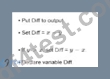
What is the first step of the algorithm?
- A. If y > x, set Diff = y - x.
- B. Deduce variable Diff
- C. Set Diff = x - y
- D. Put Diff to output
Answer: B
Explanation:
The first step in the algorithm to calculate the positive difference between two given values, x and y, is to declare the variable Diff. This is essential as it initializes the variable that will be used to store the calculated difference between x and y. The subsequent steps involve conditional statements and arithmetic operations that utilize this declared variable to compute and store the positive difference. References: N/A (as per image provided) The image shows steps of an algorithm listed in no particular order for calculating the positive difference between two values, making it relevant for understanding or teaching algorithmic logic and sequence.
NEW QUESTION # 41
Consider the given flowchart.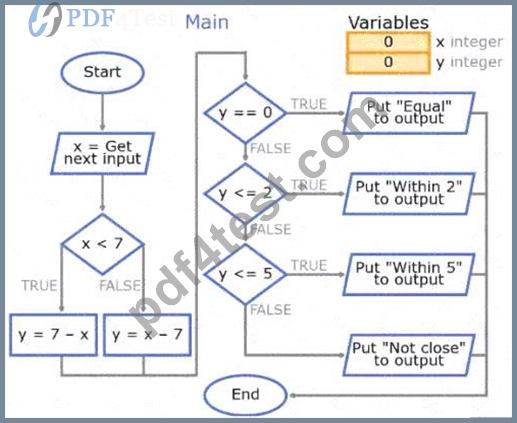
What is the output of the input is 7?
- A. Not close
- B. Within 5
- C. Equal
- D. Within 2
Answer: A
Explanation:
* Start with the input value (in this case, 7).
* Follow the flowchart's paths and apply the operations as indicated by the symbols and connectors.
* The rectangles represent processes or actions to be taken.
* The diamonds represent decision points where you will need to answer yes or no and follow the corresponding path.
* The parallelograms represent inputs/outputs within the flowchart.
* Use the input value and apply the operations as you move through the flowchart from start to finish.
NEW QUESTION # 42
What is the agile phase that results in a list of objects to be written?
- A. Analysis
- B. Design
- C. Implementation
- D. Testing
Answer: B
Explanation:
In Agile methodology, the phase that typically results in a list of objects to be written is the Design phase. This phase involves creating the architecture and design of the system to be developed. It's during this stage that developers and designers collaborate to identify the necessary objects and components that will make up the system, and how they will interact with each other. The output of this phase is often a set of design documents, diagrams, and a list of objects or components that need to be implemented in subsequent phases.
References: The Agile Development Lifecycle outlines various stages where different activities take place. The Design phase is crucial for setting a clear path for implementation and ensuring that the team has a shared understanding of the system's architecture12. Additionally, Agile methodologies like Scrum and Extreme Programming (XP) emphasize the importance of design and architecture in their practices3.
NEW QUESTION # 43
What is the outcome for the given algorithm? Round to the nearest tenth, if necessary.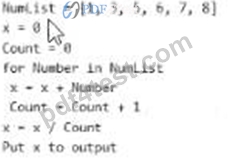
- A. 8.4
- B. 5.0
- C. 6.0
- D. 6.1
Answer: B
Explanation:
* Initialize two variables: x and Count to zero.
* Iterate through each number in the NumList.
* For each number in the list:
* Add the number to x.
* Increment Count by one.
* After processing all numbers in the list, calculate the average:
* Average = x / Count.
The NumList contains the following integers: [1, 3, 5, 6, 7, 8].
Calculating the average: (1 + 3 + 5 + 6 + 7 + 8) / 6 = 30 / 6 = 5.0.
However, none of the provided options match this result. It seems there might be an error in either the options or the calculation.
NEW QUESTION # 44
What is a feature of CM as a programming language
- A. The code does not require being translated into machine code but can be run by a separate program called a compiler.
- B. The code runs directly one statement at a time by another program called a compiler
- C. The code must be compiled into machine code in the form of an executable file before execution.
- D. The program usually runs slower than an interpreted language.
Answer: C
Explanation:
The C(M) programming language is designed to translate mathematical constructions into efficient C programs. It is a declarative functional language with strong type checking and supports high-level functional programming. The C(M) compiler translates the C(M) program into a readable C program, which then needs to be compiled into machine code in the form of an executable file before it can be executed1. This process is typical of compiled languages, where the source code is transformed into machine code, which can be directly executed by the computer's CPU. In contrast, interpreted languages are typically run by an interpreter, executing one statement at a time, which generally results in slower execution compared to compiled languages.
References: 1: The C(M) programming language - Bulgarian Academy of Sciences.
NEW QUESTION # 45
Which characteristic specifically describes an object-oriented language?
- A. Requires a compiler to convert to machine code
- B. Can be run on any machine that has an interpreter
- C. Supports creating programs as a set of functions
- D. Supports creating program as item that have data plus operations
Answer: D
Explanation:
Object-oriented programming (OOP) is characterized by the concept of encapsulating data and operations within objects. This characteristic is fundamental to OOP and distinguishes it from procedural programming, which is structured around functions rather than objects. In OOP, objects are instances of classes, which define the data (attributes) and the operations (methods) that can be performed on that data. This encapsulation of data and methods within objects allows for more modular, reusable, and maintainable code.
References: The characteristics of object-oriented programming languages are well-documented and include encapsulation, abstraction, inheritance, and polymorphism. These principles are foundational to OOP and are supported by languages like C++, Java, and Python12345.
NEW QUESTION # 46
Which expression has a value equal to the rightmost digit of the integer q = 7777?
- A. q % 10000
- B. q / 10000
- C. 10 % q
- D. q % 10
Answer: D
Explanation:
Comprehensive and Detailed Explanation From Exact Extract:
To find the rightmost digit of an integer q = 7777, we need the units digit (i.e., 7). According to foundational programming principles, the modulo operator (%) with 10 isolates the rightmost digit of a number.
* Option A: "10 % q."
* Compute: 10 % 7777 = 10 (since 10 ÷ 7777 has a remainder of 10).
* Result: 10 # 7. Incorrect.
* Option B: "q % 10."
* Compute: 7777 % 10 = 7 (remainder of 7777 ÷ 10, isolating the units digit).
* Result: 7 = rightmost digit. Correct.
* Option C: "q / 10000."
* Compute: 7777 / 10000 = 0.7777 (floating-point division).
* Result: 0.7777 # 7. Incorrect.
* Option D: "q % 10000."
* Compute: 7777 % 10000 = 7777 (since 7777 < 10000).
* Result: 7777 # 7. Incorrect.
Certiport Scripting and Programming Foundations Study Guide (Section on Modulo Operator).
C Programming Language Standard (ISO/IEC 9899:2011, Section on Multiplicative Operators).
W3Schools: "Python Operators" (https://www.w3schools.com/python/python_operators.asp).
NEW QUESTION # 47
An algorithm should output "OK" if a number is between 98.3 and 98.9, else the output is "Not OK." Which test is a valid test of the algorithm?
- A. Input 98.6. Ensure output is "Not OK."
- B. Input 99.9. Ensure output is "OK."
- C. Input 99.9. Ensure output is "98.9."
- D. Input 98.6. Ensure output is "OK."
Answer: D
Explanation:
Comprehensive and Detailed Explanation From Exact Extract:
A valid test checks if the algorithm produces the expected output for a given input, according to its specification. The algorithm outputs "OK" for numbers in the range [98.3, 98.9] (inclusive or exclusive bounds not specified, but typically inclusive in such problems) and "Not OK" otherwise. According to foundational programming principles, we evaluate each test case.
* Specification:
* Input in [98.3, 98.9] # Output: "OK".
* Input outside [98.3, 98.9] # Output: "Not OK".
* Option A: "Input 98.6. Ensure output is 'Not OK.'" Incorrect. Since 98.6 is between 98.3 and 98.9 (98.3
# 98.6 # 98.9), the output should be "OK", not "Not OK". This test is invalid.
* Option B: "Input 98.6. Ensure output is 'OK.'" Correct. 98.6 is within the range, and the expected output is "OK", making this a valid test.
* Option C: "Input 99.9. Ensure output is 'OK.'" Incorrect. 99.9 is outside the range (99.9 > 98.9), so the output should be "Not OK", not "OK". This test is invalid.
* Option D: "Input 99.9. Ensure output is '98.9.'" Incorrect. The algorithm outputs either "OK" or "Not OK", not a numerical value like "98.9". This test is invalid.
Certiport Scripting and Programming Foundations Study Guide (Section on Algorithm Testing).
General Programming Principles: Testing and Validation.
W3Schools: "Python Conditions" (https://www.w3schools.com/python/python_conditions.asp).
NEW QUESTION # 48
The steps in an algorithm to find the maximum of integers a and b are given.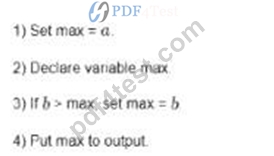
Which two steps of the algorithm should be switched to make the algorithm successful?
- A. 2 and 4
- B. 1 and 3
- C. 2 and 3
- D. 1 and 2
Answer: D
Explanation:
The variable max should be declared before it is used. So, the corrected algorithm would be:
* Declare variable max.
* Set max = a.
* If b > max, set max = b.
* Put max to output.
This way, the variable max is declared before being assigned the value of a, and the rest of the algorithm can proceed as given. Thank you for the question! Let me know if you have any other queries.
NEW QUESTION # 49
Which expression has a values equal to the rightmost digit of the integer q = 16222?
- A. 10 % q
- B. Q % 10
- C. Q / 100000
- D. Q % 10000````````````````````
Answer: B
Explanation:
The modulus operator % is used to find the remainder of a division of two numbers. When you use q % 10, you are essentially dividing q by 10 and taking the remainder, which will always be the rightmost digit of q in base 10. This is because our number system is decimal (base 10), and any number modulo 10 will yield the last digit of that number. For example, 16222 % 10 will give 2, which is the rightmost digit of 16222.
References: The explanation aligns with standard programming practices and mathematical operations as verified by multiple programming resources1
NEW QUESTION # 50
A programmer is writing code using C. Which paradigm could the programmer be using?
- A. An event-driven paradigm using static types
- B. A functional paradigm using dynamic types
- C. A procedural paradigm using dynamic types
- D. A procedural paradigm using sialic types
Answer: D
Explanation:
C is a programming language that primarily follows the procedural programming paradigm1. This paradigm is a subset of imperative programming and emphasizes on procedure in terms of the underlying machine model1. It involves writing a sequence of instructions to tell the computer what to do step by step, and it relies on the concept of procedure calls, where procedures, also known as routines, subroutines, or functions, are a set of instructions that perform a specific task1.
The procedural paradigm in C uses static typing, where the type of a variable is known at compile time1. This means that the type of a variable is declared and does not change over time, which is in contrast to dynamic typing, where the type can change at runtime. C's type system requires that each variable and function is explicitly declared with a type and it does not support dynamic typing as seen in languages like Python or JavaScript1.
NEW QUESTION # 51
Which statement describes a compiled language?
- A. It runs one statement at a time by another program without the need for compilation.
- B. It is considered fairly safe because it forces the programmer to declare all variable types ahead of time and commit to those types during runtime.
- C. It has code that is first converted to an executable file, and then run on a particular type of machine.
- D. It can be run right away without converting the code into an executable file.
Answer: C
Explanation:
A compiled language is one where the source code is translated into machine code, which is a set of instructions that the computer's processor can execute directly. This translation is done by a program called a compiler. Once the source code is compiled into an executable file, it can be run on the target machine without the need for the original source code or the compiler. This process differs from interpreted languages, where the code is executed one statement at a time by another program called an interpreter, and there is no intermediate executable file created.
Option A describes an interpreted language, not a compiled one. Option B refers to type safety, which is a feature of some programming languages but is not specific to compiled languages. Option C describes a script or an interpreted language, which can be executed immediately by an interpreter without compilation.
NEW QUESTION # 52
Which action occurs the design phase of an agile process?
- A. Deciding on the scope of the program
- B. Determining the goals of the project.
- C. Wring the required objects
- D. Determining the functions that need to be written
Answer: D
Explanation:
During the design phase of an agile process, the focus is on determining the functions that need to be written.
This involves understanding the user requirements and defining the system architecture to meet those needs.
The design phase is iterative, allowing for continuous refinement and improvement of the design as more is learned about the system and its users. It's a collaborative effort involving designers, developers, and stakeholders to ensure that the functions align with the goals of the project and the needs of the users.
References: The explanation is based on the agile design principles which emphasize iterative development, collaboration, and adaptability. Agile design processes guide the creation of software by focusing on customer needs and iterative improvement
NEW QUESTION # 53
A sequence diagram is shown: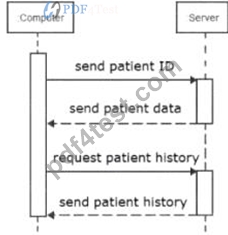
What is the purpose of a sequence diagram?
- A. It illustrates the communication steps for a particular software scenario.
- B. It depicts program operations, branches, and loops.
- C. It outlines the potential actions of a user
- D. It outlines the needed computations.
Answer: A
Explanation:
A sequence diagram is a type of interaction diagram that details how operations are carried out within a system. It is used to model the interactions between objects or components in a sequence that reflects the order of operations, particularly focusing on the messages exchanged between these objects over time. The vertical axis of a sequence diagram represents time, and the horizontal axis represents the objects involved in the interaction. The purpose of a sequence diagram is to illustrate the sequence of messages or events that occur between these objects, typically in the context of a specific use case or scenario within the software system1234.
References:
* The information provided is based on standard practices in software engineering and UML (Unified Modeling Language) documentation. For further reading on sequence diagrams and their applications, you can refer to resources such as Visual Paradigm1, Creately2, IBM Developer3, and Lucidchart4.
NEW QUESTION # 54
The steps in an algorithm to buy a pair of shoes from a store are given in no particular order.
* Bring the shoes to the cashier
* Pay for the shoes
* Enter the store
* Select the pair of shoes
What is the first step of the algorithm?
- A. Pay for the shoes.
- B. Bring the shoes to the cashier.
- C. Select the pair of shoes.
- D. Enter the store
Answer: D
Explanation:
An algorithm is a set of step-by-step instructions for completing a task. In the context of buying a pair of shoes from a store, the first logical step would be to enter the store. This is because one cannot select a pair of shoes, bring them to the cashier, or pay for them without first entering the store. The steps should follow a logical sequence based on the dependencies of each action:
* Enter the store - This is the initial step as it allows access to the shoes available for purchase.
* Select the pair of shoes - Once inside, the next step is to choose the desired pair of shoes.
* Bring the shoes to the cashier - After selection, the shoes are taken to the cashier for payment.
* Pay for the shoes - The final step is the transaction to exchange money for the shoes.
References:
* The concept of algorithms and their properties can be found in computer science and programming literature, such as "Introduction to Algorithms" by Cormen, Leiserson, Rivest, and Stein.
* The logical ordering of steps in a process is a fundamental aspect of algorithm design, which is covered in foundational programming and scripting courses.
NEW QUESTION # 55
A function should return 0 if a number, N is even and 1 if N is odd.
What should be the input to the function?
- A. Even
- B. N
- C. 0
- D. 1
Answer: B
Explanation:
In the context of writing a function that determines whether a given number N is even or odd, the input to the function should be the number itself, represented by the variable N. The function will then perform the necessary logic to determine whether N is even or odd and return the appropriate value (0 for even, 1 for odd).
Here's how the function might look in Python:
Python
def check_even_odd(N):
"""
Determines whether a given number N is even or odd.
Args:
N (int): The input number.
Returns:
int: 0 if N is even, 1 if N is odd.
"""
if N % 2 == 0:
return 0 # N is even
else:
return 1 # N is odd
# Example usage:
number_to_check = 7
result = check_even_odd(number_to_check)
print(f"The result for {number_to_check} is: {result}")
AI-generated code. Review and use carefully. More info on FAQ.
In this example, if number_to_check is 7, the function will return 1 because 7 is an odd number.
NEW QUESTION # 56
......
Free Courses and Certificates Scripting-and-Programming-Foundations Exam Question: https://validtorrent.pdf4test.com/Scripting-and-Programming-Foundations-actual-dumps.html
