

300-215 Free Study Guide! with New Update 118 Exam Questions
Get up-to-date Real Exam Questions for 300-215 UPDATED [2025]
Cisco 300-215 exam is a certification exam designed to test the knowledge and skills of cybersecurity professionals in conducting forensic analysis and incident response using Cisco technologies. 300-215 exam is part of the Cisco CyberOps Associate certification program, which aims to equip professionals with the necessary skills to identify and respond to cybersecurity threats. Passing 300-215 exam is a requirement for obtaining the Cisco CyberOps Associate certification.
Cisco 300-215 is a certification exam that focuses on conducting forensic analysis and incident response using Cisco technologies for CyberOps. 300-215 exam is designed to validate the skills of CyberOps professionals who specialize in detecting and responding to security incidents. Conducting Forensic Analysis & Incident Response Using Cisco Technologies for CyberOps certification is ideal for those who want to sharpen their skills in network security and incident response.
NEW QUESTION # 49
Refer to the exhibit.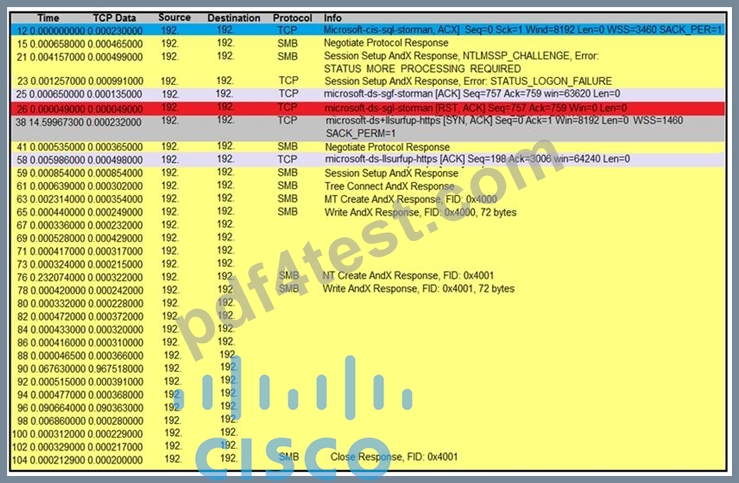
An engineer is analyzing a TCP stream in Wireshark after a suspicious email with a URL. What should be determined about the SMB traffic from this stream?
- A. It is redirecting to a malicious phishing website
- B. It is requesting authentication on the user site.
- C. It is exploiting redirect vulnerability
- D. It is sharing access to files and printers.
Answer: D
Explanation:
The Wireshark output shows SMB protocol transactions, including NT Create AndX Response and Write AndX Response, indicating the transfer of files or objects. SMB (Server Message Block) is a protocol used for file sharing and printer access in Windows networks. The log does not indicate phishing or redirection behavior but rather normal SMB communication such as accessing files or shared resources.
-
NEW QUESTION # 50
An investigator is analyzing an attack in which malicious files were loaded on the network and were undetected. Several of the images received during the attack include repetitive patterns. Which anti-forensic technique was used?
- A. obfuscation
- B. spoofing
- C. tunneling
- D. steganography
Answer: D
Explanation:
The use of repetitive patterns in images is a known indicator of steganography, which is an anti-forensics technique used to hide malicious code or files inside seemingly benign content such as image or audio files.
The repetitive patterns suggest that the image may contain embedded hidden data. This technique is particularly difficult to detect through conventional scanning or antivirus software.
According to theCyberOps Technologies (CBRFIR) 300-215 study guide, steganography is defined as
"concealing malicious content or instructions within ordinary files such as .jpg, .png, or audio files, allowing the content to bypass security filters and reach the target system without detection".
-
NEW QUESTION # 51
Refer to the exhibit.
What is occurring?
- A. The request was redirected.
- B. The requested page was not found.
- C. WAF detected code injection.
- D. An attacker attempted SQL injection.
Answer: B
Explanation:
Comprehensive and Detailed Explanation:
The log entry contains the following key elements:
* The timestamp:(04/Jan/2022:20:18:06 +0000)
* HTTP method and URI:"GET /%60%60%60%60%60%60/ HTTP/2.0"
* HTTP status code:404
* User-Agent:Mozilla/5.0 ... Firefox/95.0
The status code404indicates that the requested resource was not found on the server. This is a standard HTTP response that signifies the server could not locate the requested URI (in this case, likely due to a malformed or invalid path/\`````/, where%60is the URL-encoded form of the backtick character "").
There is no clear evidence of SQL injection, WAF detection, or redirection in this log. The use of encoded backticks may suggest probing behavior, but the log does not show a definitive attack signature.
Therefore, the correct interpretation is:
D: The requested page was not found.
NEW QUESTION # 52
Refer to the exhibit.
An engineer received a ticket to analyze a recent breach on a company blog. Every time users visit the blog, they are greeted with a message box. The blog allows users to register, log in, create, and provide comments on various topics. Due to the legacy build of the application, it stores user information in the outdated MySQL database. What is the recommended action that an engineer should take?
- A. Upgrade the MySQL database.
- B. Implement TLS 1.3 for external communications.
- C. Match the web server software for the front-end and back-end servers.
- D. Validate input on arrival as strictly as possible.
Answer: D
Explanation:
The alert box in the screenshot ("HACKED BY 1337") is a classic sign ofCross-Site Scripting (XSS). This occurs when unvalidated input is executed as code in a browser.
To prevent this:
* TheCisco CyberOps Associateguide recommendsstrict input validationas the primary defense against XSS and similar web-based injection attacks.
NEW QUESTION # 53
What is an antiforensic technique to cover a digital footprint?
- A. authorization
- B. privilege escalation
- C. authentication
- D. obfuscation
Answer: D
Explanation:
Antiforensic techniques are methods attackers use to cover their tracks. According to the Cisco CyberOps curriculum, "obfuscation" refers to techniques such as encoding, encrypting, or otherwise disguising commands, payloads, or scripts to avoid detection and analysis. This is a standard antiforensic tactic used to prevent attribution and hinder forensic investigation.
Options like privilege escalation and authentication are part of attack vectors or access control and not antiforensic methods.
NEW QUESTION # 54
An "unknown error code" is appearing on an ESXi host during authentication. An engineer checks the authentication logs but is unable to identify the issue. Analysis of the vCenter agent logs shows no connectivity errors. What is the next log file the engineer should check to continue troubleshooting this error?
- A. var/log/shell.log
- B. var/log/general/log
- C. /var/log/vmksummary.log
- D. /var/log/syslog.log
Answer: D
NEW QUESTION # 55
Refer to the exhibit.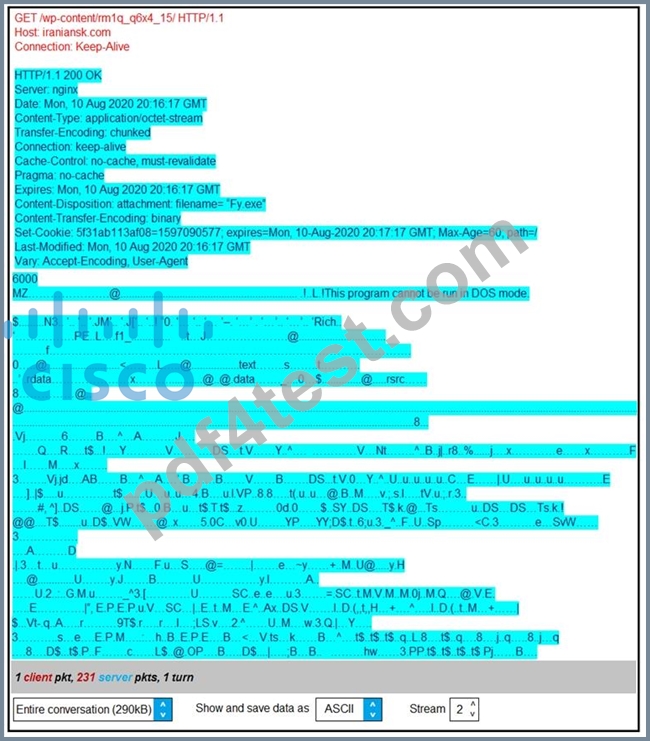
According to the Wireshark output, what are two indicators of compromise for detecting an Emotet malware download? (Choose two.)
- A. Domain name: iraniansk.com
- B. Server: nginx
- C. Content-Type: application/octet-stream
- D. Hash value: 5f31ab113af08=1597090577
- E. filename= "Fy.exe"
Answer: A,E
Explanation:
From the Wireshark capture:
* A (iraniansk.com): This domain isnot a known legitimate resourceand is hosting a suspicious file named "Fy.exe," strongly indicative of amalware distribution domain.
* D (Fy.exe): TheContent-Disposition: attachment; filename="Fy.exe"header explicitly signals abinary executabledownload, a key indicator in Emotet campaigns.
WhileContent-Type: application/octet-stream(E) is typical of binary data transfers, it isnot uniqueto malware and cannot by itself serve as a strong IoC. Thenginx server (B)andcookie/hash string (C)similarly do not uniquely indicate compromise.
NEW QUESTION # 56
Refer to the exhibit.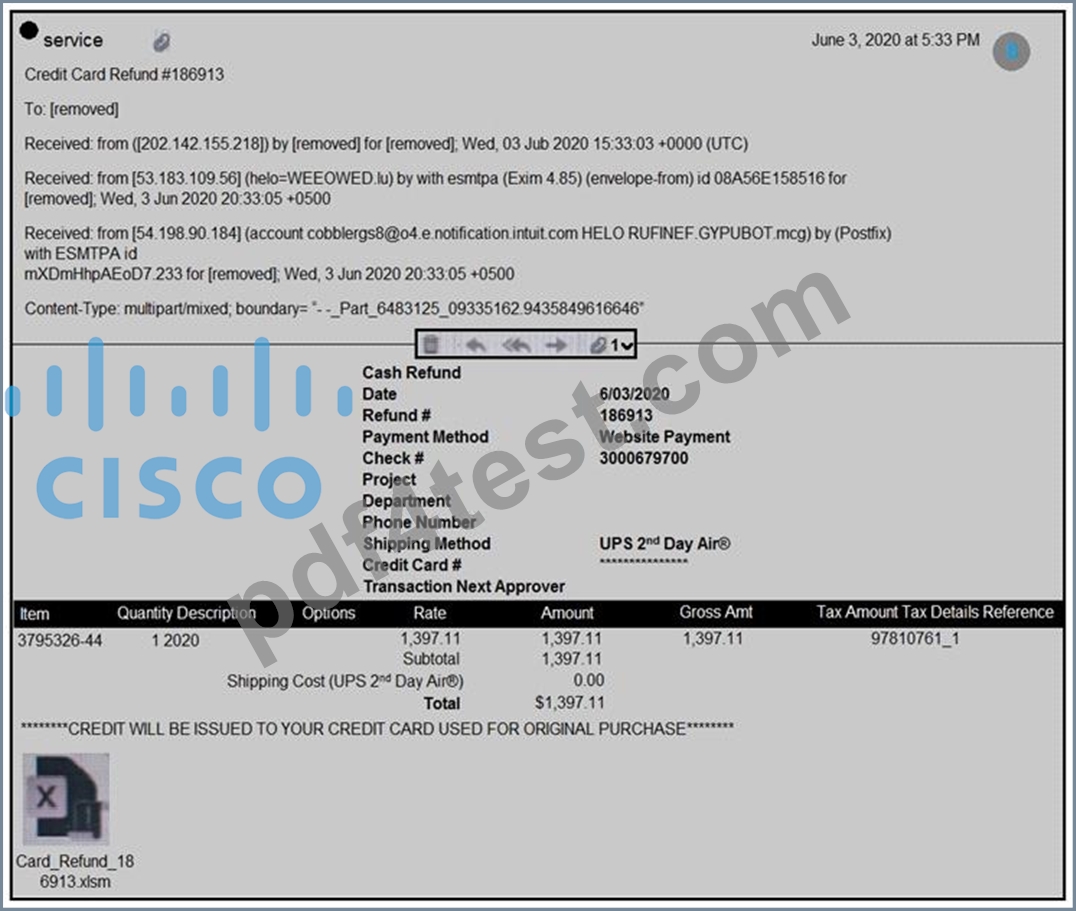
Which element in this email is an indicator of attack?
- A. content-Type: multipart/mixed
- B. subject: "Service Credit Card"
- C. IP Address: 202.142.155.218
- D. attachment: "Card-Refund"
Answer: D
NEW QUESTION # 57
Which tool is used for reverse engineering malware?
- A. Ghidra
- B. SNORT
- C. Wireshark
- D. NMAP
Answer: A
Explanation:
Ghidrais a free and open-source software reverse engineering (SRE) suite developed by the NSA. It includes disassembly, decompilation, and debugging tools specifically designed for analyzing malware and other compiled programs.
The Cisco CyberOps guide referencesGhidraas a top tool for reverse engineering binary files during malware analysis tasks, making it ideal for understanding malicious code behavior at a deeper level.
NEW QUESTION # 58
An employee receives an email from a "trusted" person containing a hyperlink that is malvertising. The employee clicks the link and the malware downloads. An information analyst observes an alert at the SIEM and engages the cybersecurity team to conduct an analysis of this incident in accordance with the incident response plan. Which event detail should be included in this root cause analysis?
- A. alarm raised by the SIEM
- B. alert identified by the cybersecurity team
- C. information from the email header
- D. phishing email sent to the victim
Answer: A
NEW QUESTION # 59
What is a concern for gathering forensics evidence in public cloud environments?
- A. Timeliness: Gathering forensics evidence from cloud service providers typically requires substantial time.
- B. Configuration: Implementing security zones and proper network segmentation.
- C. Multitenancy: Evidence gathering must avoid exposure of data from other tenants.
- D. High Cost: Cloud service providers typically charge high fees for allowing cloud forensics.
Answer: C
Explanation:
One of the primary concerns when gathering forensic evidence in public cloud environments is the issue of multitenancy. In a shared cloud infrastructure, multiple tenants (organizations or users) operate on the same physical hardware, using virtualization to logically separate resources. This architecture poses a significant challenge for forensic investigations because:
* Forensic investigators must ensure that they do not inadvertently access or expose data belonging to other tenants while collecting evidence.
* This can limit access to low-level system data or hardware-level logs that might be essential for a thorough forensic analysis, since providers must enforce strict data isolation policies.
* This concern is recognized in industry practices and guidelines, including NIST SP 800-86, which underscores the need to collect data in a forensically sound and legally defensible manner-something made more complex in shared environments.
The Cisco CyberOps Associate guide emphasizes the challenges of evidence handling in cloud environments, stating that "gathering evidence in the cloud must be carefully performed to ensure compliance with legal standards and to respect the boundaries of other tenants' data".
Reference:CyberOps Technologies (CBRFIR) 300-215 study guide, Chapter on Digital Forensics and Cloud Environments, Section: Evidence Collection in Shared Infrastructure (Public Cloud).
NEW QUESTION # 60
Refer to the exhibit.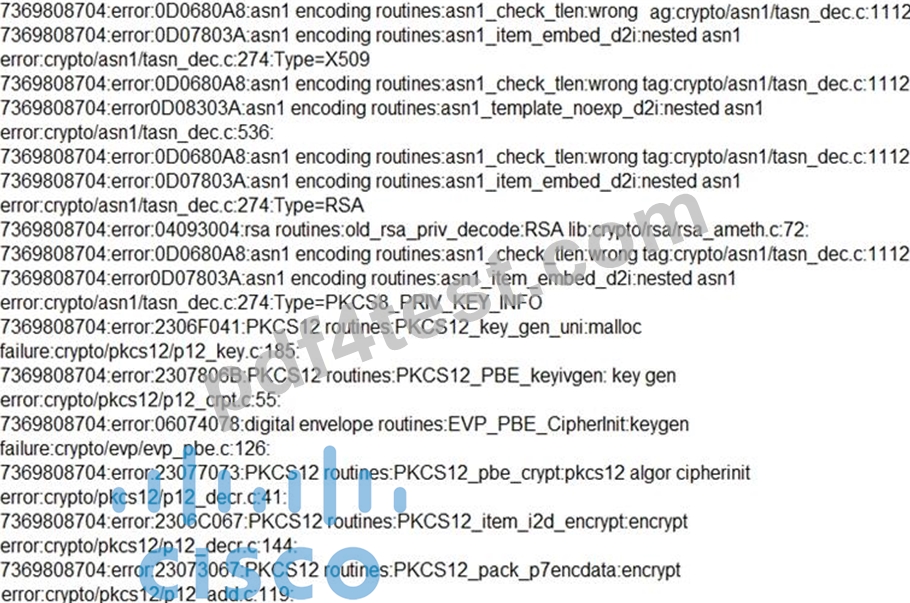
What should be determined from this Apache log?
- A. The certificate file has been maliciously modified
- B. A module named mod_ssl is needed to make SSL connections.
- C. The SSL traffic setup is improper
- D. The private key does not match with the SSL certificate.
Answer: D
Explanation:
The error logs indicate multiplePKCS12andASN.1 decodingerrors, such as:
* PKCS12 routines:PKCS12_parse:mac verify failure
* rsa routines:old_rsa_priv_decode:RSA lib
* PKCS12 routines:PKCS12_key_gen_uni:malloc
These specific errors most commonly occur when:
* Theprivate key does not correspondto the certificate being used.
* There is amismatchbetween the public and private key pair required for SSL handshakes.
This is a well-documented condition in Apache SSL configuration issues and explicitly covered under TLS
/SSL troubleshooting sections in cybersecurity operations contexts. The Cisco CyberOps guide also notes that SSL errors with key verification usually result from "improper key/certificate pairing" rather than file corruption or missing modules.
Thus, the correct answer is:
B). The private key does not match with the SSL certificate.
NEW QUESTION # 61
A threat actor has successfully attacked an organization and gained access to confidential files on a laptop.
What plan should the organization initiate to contain the attack and prevent it from spreading to other network devices?
- A. attack surface
- B. incident response
- C. root cause
- D. intrusion prevention
Answer: B
Explanation:
Once an incident has occurred, the appropriate course of action is to engage the organization's Incident Response (IR) plan. This is a structured approach to contain, analyze, and eradicate threats before they spread across the network.
The Cisco CyberOps Associate study guide emphasizes:
* "Incident response and handling are essential within an organization... The main objective of implementing an incident handling process is to reduce the impact of a cyber-attack, ensure the damages caused are assessed, and implement recovery procedures".
* In particular, the containment phase of IR is focused on isolating the threat and preventing lateral movement or further compromise.
Options such as "root cause" or "attack surface" are relevant at later stages of analysis and mitigation, not immediate containment. Therefore, the correct answer is C.
NEW QUESTION # 62
Refer to the exhibit.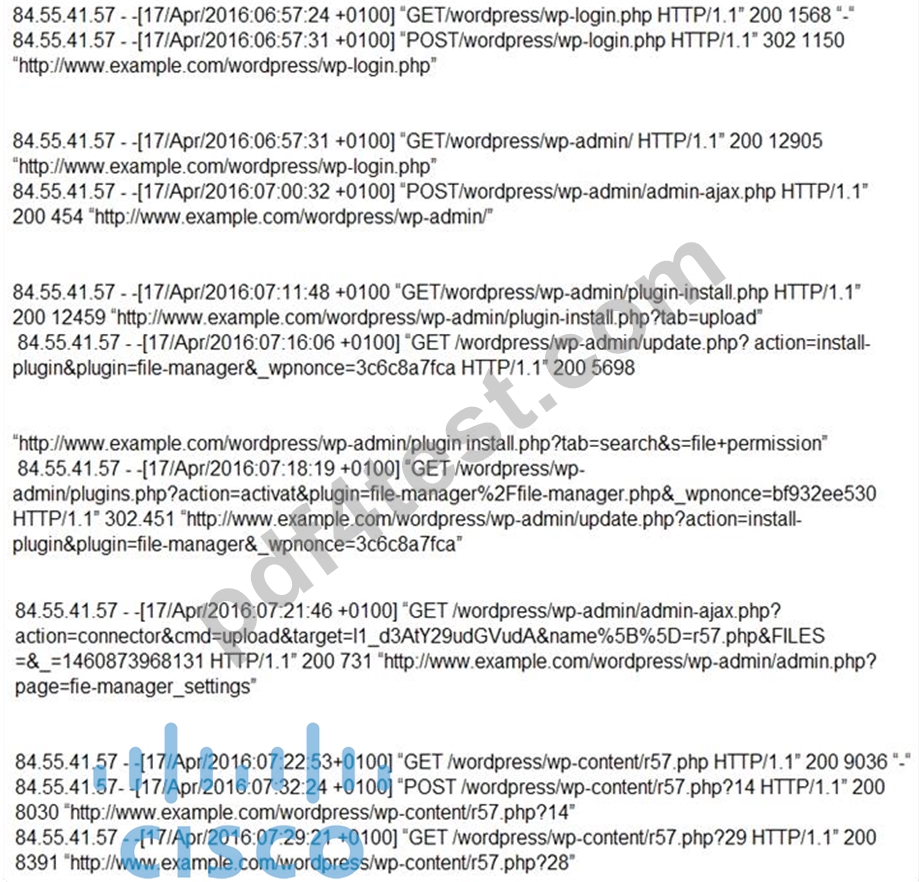
Which two determinations should be made about the attack from the Apache access logs? (Choose two.)
- A. The attacker used the word press file manager plugin to upoad r57.php.
- B. The attacker performed a brute force attack against word press and used sql injection against the backend database.
- C. The attacker used r57 exploit to elevate their privilege.
- D. The attacker logged on normally to word press admin page.
- E. The attacker uploaded the word press file manager trojan.
Answer: A,B
NEW QUESTION # 63
A cybersecurity analyst is analyzing a complex set of threat intelligence data from internal and external sources. Among the data, they discover a series of indicators, including patterns of unusual network traffic, a sudden increase in failed login attempts, and multiple instances of suspicious file access on the company's internal servers. Additionally, an external threat feed highlights that threat actors are actively targeting organizations in the same industry using ransomware. Which action should the analyst recommend?
- A. Notify of no requirement for immediate action because the suspicious file access incidents are normal operational activities and do not indicate an ongoing threat.
- B. Propose isolation of affected systems and activating the incident response plan because the organization is likely under attack by the new ransomware strain.
- C. Advise on monitoring the situation passively because network traffic anomalies are coincidental and unrelated to the ransomware threat.
- D. Advocate providing additional training on secure login practices because the increase in failed login attempts is likely a result of employee error.
Answer: B
Explanation:
The described scenario includes both internal alerts (unusual network traffic, failed logins, suspicious file access) and external intelligence indicating active ransomware campaigns in the same industry. This constitutes a strong combination of precursors and indicators, as defined in the NIST SP 800-61 incident handling model and reinforced in the Cisco CyberOps Associate curriculum.
According to the Cisco guide:
* "Once an incident has occurred, the IR team needs to contain it quickly before it affects other systems and networks within the organization."
* "The containment phase is crucial in stopping the threat from spreading and compromising more systems".
Given these indicators and the high-value nature of the data involved, it is essential to proactively isolate suspected systems and activate the incident response plan to prevent damage from potential ransomware.
-
NEW QUESTION # 64
Drag and drop the steps from the left into the order to perform forensics analysis of infrastructure networks on the right.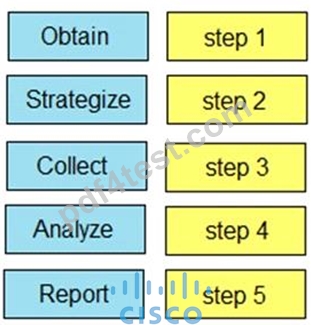
Answer:
Explanation: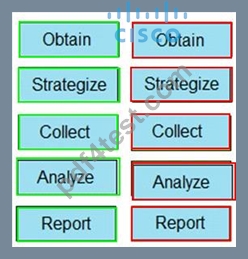
NEW QUESTION # 65
A threat actor attempts to avoid detection by turning data into a code that shifts numbers to the right four times. Which anti-forensics technique is being used?
- A. poisoning
- B. tunneling
- C. obfuscation
- D. encryption
Answer: C
Explanation:
This scenario describes asubstitution cipher, where data is made unreadable or less recognizable without altering its functionality. According to the Cisco CyberOps Associate guide, obfuscation includes techniques such as shifting, encoding, and symbol manipulation to mask the true nature of data or code:
"A very well-known cipher, the Caesar cipher... shifts the letter of the alphabet by a fixed number... This technique is a form of data obfuscation used to bypass detection mechanisms.".
NEW QUESTION # 66
A security team received reports of users receiving emails linked to external or unknown URLs that are non- returnable and non-deliverable. The ISP also reported a 500% increase in the amount of ingress and egress email traffic received. After detecting the problem, the security team moves to the recovery phase in their incident response plan. Which two actions should be taken in the recovery phase of this incident? (Choose two.)
- A. request packet capture
- B. scan hosts with updated signatures
- C. verify the breadth of the attack
- D. collect logs
- E. remove vulnerabilities
Answer: B,E
NEW QUESTION # 67
Refer to the exhibit.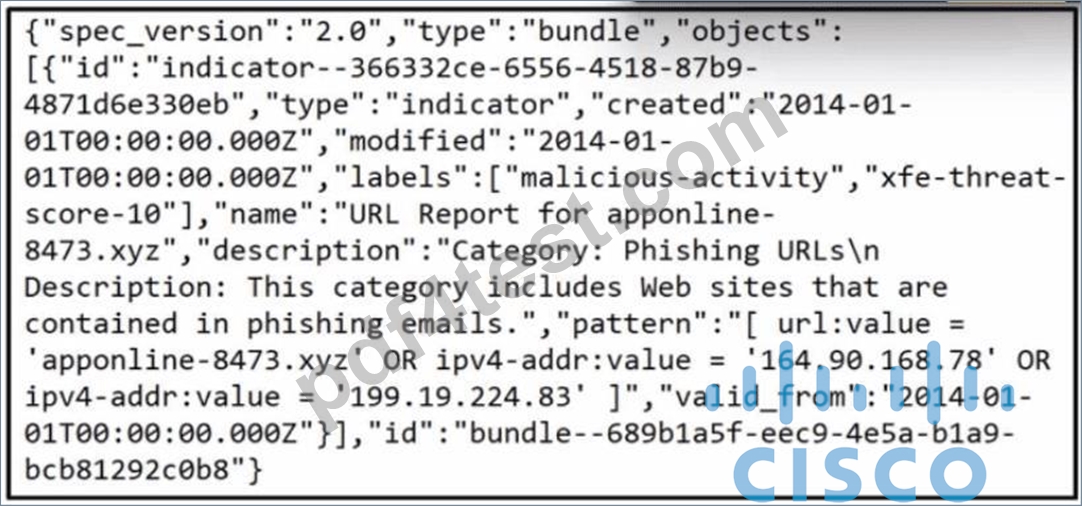
Which two actions should be taken as a result of this information? (Choose two.)
- A. Block any access to and from domain apponline-8473.xyz.
- B. Blacklist IPs 164.90.168.78 and 199.19.224.83.
- C. Block any URLs in received emails.
- D. Block all emails sent from malicious domain apponline-8473.xyz.
- E. Block any malicious activity with xfe-threat-score-10.
Answer: A,B
Explanation:
Comprehensive and Detailed Explanation:
The exhibit contains STIX (Structured Threat Information Expression) formatted threat intelligence indicating:
* A phishing indicator related to the domain:apponline-8473.xyz
* Associated malicious IP addresses:164.90.168.78and199.19.224.83
* Labelled as "malicious-activity" with "xfe-threat-score-10"
Based on this:
* Option B is correct: The IP addresses explicitly listed in the pattern field should be blacklisted to prevent command-and-control or malicious connections.
* Option C is correct: The domainapponline-8473.xyzis also listed and flagged as involved in phishing, so DNS and firewall rules should block access to and from this domain.
Options A and E are too broad or speculative; the data specifies a specific domain, not a generic block on all emails or URLs. Option D refers to a label used for classification and not a directly actionable item.
Therefore, the correct answers are: B and C.
NEW QUESTION # 68
Data has been exfiltrated and advertised for sale on the dark web. A web server shows:
* Database unresponsiveness
* PageFile.sys changes
* Disk usage spikes with CPU spikes
* High page faults
Which action should the IR team perform on the server?
- A. Check the Memory.dmp file in the Windows directory for memory leak indications
- B. Examine the system.cfg file in the Windows directory for improper system configurations
- C. Analyze the PageFile.sys file in the System Drive and the Virtual Memory configuration
- D. Review the database.log file in the program files directory for database errors
Answer: C
Explanation:
The combination of CPU spikes, disk usage peaks, and fluctuating PageFile.sys indicates excessive virtual memory paging, which may be a sign of malicious memory or file access behavior. PageFile.sys is part of the virtual memory system, and analyzing it can reveal which processes or payloads are consuming unusual amounts of memory, especially during exfiltration events.
NEW QUESTION # 69
A scanner detected a malware-infected file on an endpoint that is attempting to beacon to an external site. An analyst has reviewed the IPS and SIEM logs but is unable to identify the file's behavior. Which logs should be reviewed next to evaluate this file further?
- A. Antivirus solution
- B. network device
- C. DNS server
- D. email security appliance
Answer: C
NEW QUESTION # 70 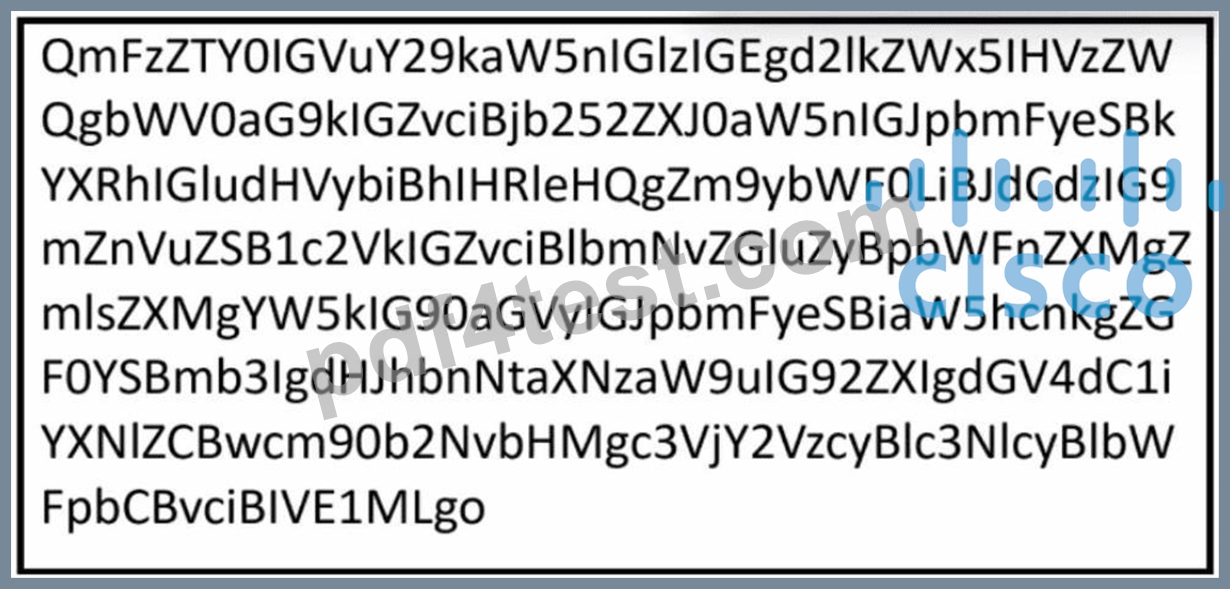
- A. JavaScript
- B. hexadecimal
- C. Base64
- D. ascii85
Answer: C
Explanation:
The string in the exhibit is a classic example of Base64 encoding. Base64 is used to encode binary data into ASCII characters, making it suitable for transmitting data over media that are designed to deal with textual data. It typically ends with one or two equal signs=(padding), which this string does. This format is commonly seen in obfuscated payloads or malware communications in the wild.
NEW QUESTION # 71 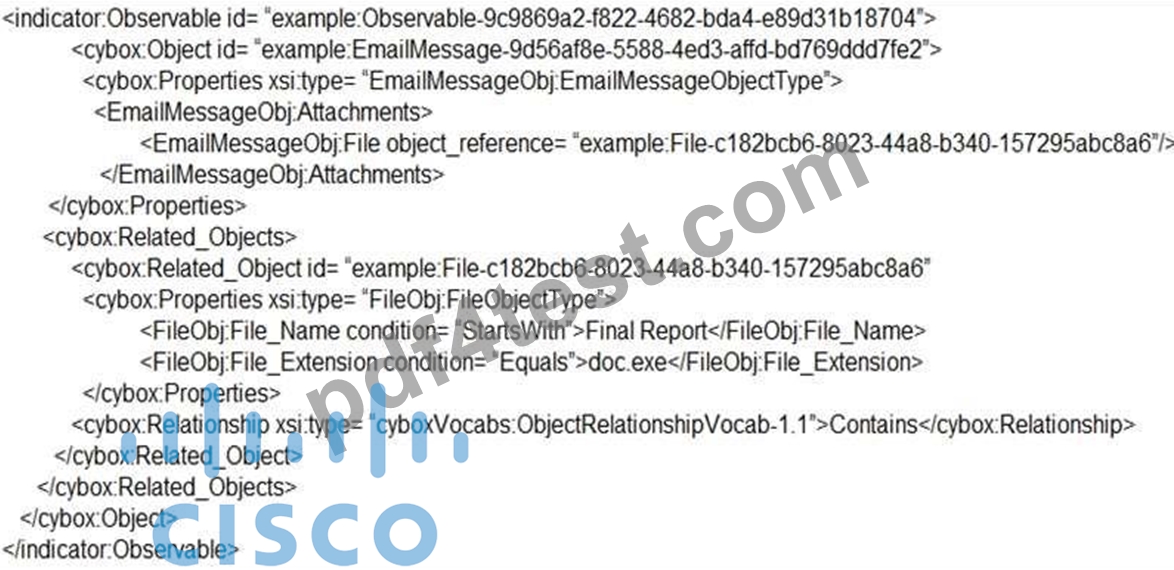
Refer to the exhibit. Which determination should be made by a security analyst?
- A. An email was sent with an attachment named "Final Report.doc".
- B. An email was sent with an attachment named "Final Report.doc.exe".
- C. An email was sent with an attachment named "Grades.doc.exe".
- D. An email was sent with an attachment named "Grades.doc".
Answer: B
NEW QUESTION # 72
An investigator notices that GRE packets are going undetected over the public network. What is occurring?
- A. decryption
- B. steganography
- C. tunneling
- D. encryption
Answer: C
Explanation:
Generic Routing Encapsulation (GRE) is a tunneling protocol used to encapsulate a wide variety of network layer protocols inside point-to-point connections. If packets encapsulated with GRE are bypassing monitoring tools, it's likely due to tunneling-where payloads are hidden within another protocol. Tunneling can obscure malicious content or lateral movement in a network and is a common method used in data exfiltration.
Reference:CyberOps Technologies (CBRFIR) 300-215 study guide, Chapter on Network Protocols and Evasion Techniques.
-
NEW QUESTION # 73
Refer to the exhibit.
A security analyst is reviewing alerts from the SIEM system that was just implemented and notices a possible indication of an attack because the SSHD system just went live and there should be nobody using it. Which action should the analyst take to respond to the alert?
- A. Ignore the alert and continue monitoring for further activity because the system was just implemented.
- B. Investigate the alert by checking SSH logs and correlating with other relevant data in SIEM.
- C. Reset the admin password in SSHD to prevent unauthorized access to the system at scale.
- D. Immediately block the IP address 192.168.1.100 from accessing the SSHD environment.
Answer: B
Explanation:
The log entry shows a failed SSH login attempt for an invalid user "admin" from IP192.168.1.100. As the system has just gone live and no legitimate use is expected, this could be an early reconnaissance or brute- force attempt. However, blocking IPs or resetting passwords without fully understanding the context could lead to incomplete remediation or false positives.
According to Cisco CyberOps best practices, the first step is to thoroughly investigate the alert by correlating it with other logs (e.g., authentication logs, IDS/IPS logs) to determine the intent and scope of activity.
-
NEW QUESTION # 74
......
The Cisco 300-215 course is designed for IT professionals who are responsible for ensuring the security of their organization's networks. They may be network administrators, security analysts, incident responders, or any other IT professionals whose job includes investigating security incidents.
Pass Cisco 300-215 Exam in First Attempt Guaranteed: https://validtorrent.pdf4test.com/300-215-actual-dumps.html
