

2026 Realistic CORe Dumps Questions To Gain Brilliant Result
Start your CORe Exam Questions Preparation with Updated 316 Questions
The HBX CORe program is an excellent way for individuals to gain a strong foundation in business concepts and skills. The final exam is a rigorous test of participants' knowledge and understanding of the material covered in the program. Those who pass the exam receive a HBX CORe certification, which demonstrates to employers and colleagues that they have a solid foundation in business concepts and skills.
NEW QUESTION # 170
A student is interested in which factors affect the U.S. poverty rate and develops a linear regression model. The student uses poverty rate in all 50
U.S. states and Washington D.C. as the dependent variable and wants to relate it to the following variables:
The unemployment rate
The percent of the adult (over 25) population with at least a bachelor's degree
The percent of the population without health insurance
The percent of the adult (over 25) population without a high school diploma or equivalent
The percent of households with children under 18 run by a single mother
The student collects data from each state and Washington D.C. for the year 2012 and runs the regression in Excel. The results of this regression are given below.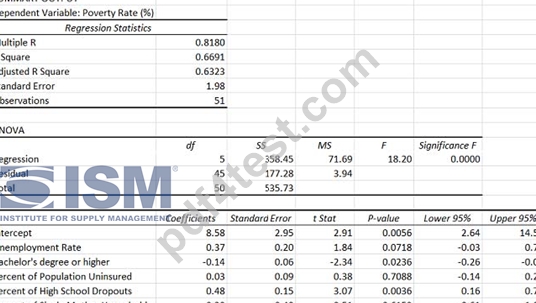
Based on these results, select the independent variables that have a coefficient that is statistically significant at the 5% level. (Select all that apply.)
- A. Unemployment Rate
- B. Percent of Population Uninsured
- C. Percent of High School Dropouts
- D. Bachelor's Degree or Higher
- E. Percent of Single Mother Households
Answer: C,D
NEW QUESTION # 171
Telling a seller during negotiations that "This is our best and final offer" is a(n)
- A. effective tactic that typically yields an optimum result
- B. strategic move that can shorten an otherwise lengthy negotiation, which should only be used when strong benchmarking supports the offer
- C. tactic that should be avoided regardless of the circumstances, due to its potential harm to the client-supplier relationship
- D. risky negotiating tactic that should be used with caution, and only if the buyer has a suitable alternative
Answer: D
Explanation:
* Context of Negotiation: The phrase "This is our best and final offer" is a strong statement in negotiations.
* Risk Assessment: This tactic can abruptly end negotiations if the other party is not willing to accept the terms.
* Alternative Readiness: Using this tactic effectively requires the buyer to have a viable alternative in case the offer is rejected.
* Strategic Use: It should be employed when the buyer is confident that the offer is competitive and fair, and when there is leverage from alternative suppliers or options.
* Potential Drawbacks: It might strain relationships if perceived as inflexible or final.
* Conclusion: While it can shorten negotiations, it carries significant risk and should be used judiciously with alternative plans in place.
References
* Getting to Yes: Negotiating Agreement Without Giving In by Roger Fisher and William Ury.
* Negotiation Genius: How to Overcome Obstacles and Achieve Brilliant Results at the Bargaining Table and Beyond by Deepak Malhotra and Max H. Bazerman.
NEW QUESTION # 172
Which of the following is the BEST course of action to take in order to develop a positive working relationship with a supplier?
- A. Invite engineering and production to meet with the supplier
- B. Involve upper management in discussions with the supplier
- C. Involve Internal customers in team discussions with the supplier
- D. Work with the supplier one-on-one to develop a personal relationship
Answer: C
NEW QUESTION # 173
DEF, Inc. is a medium-sized manufacturer in the precious metals industry. Continued price increases in precious metals have put a strain on the financial resources of suppliers, and while some have closed their businesses, others have converted to lower cost metals. DEF's supply manager is concerned not only about the evaporation of the specialty supply base but also that marketing efforts into new online markets are providing new growth and renewed demand for long-established product lines. The supply manager determines that although little precious raw material Is used internally in the organization, the combined volumes from component manufacturers are large and growing.
Which of the following should the supply manager employ to gain value under these conditions?
- A. Transformation management
- B. Value stream mapping
- C. Multi-tier purchasing agreements
- D. Risk avoidance
Answer: C
NEW QUESTION # 174
GHI, Inc. is a manufacturer of batteries. GHI's supply manager reads an industry publication describing a new innovation from DEF Company that extends battery capacity, which could be of tremendous benefit to GHI.
DEF happens to be a supplier to GHI, and yet DEF's sales representative has never mentioned the innovation to the supply manager. In order to strengthen the business relationship and enhance future collaboration between GHI and DEF, the supply manager should
- A. implement a supplier forum
- B. launch a joint process improvement program
- C. conduct comprehensive business reviews
- D. enter into a strategic alliance
Answer: D
Explanation:
Entering into a strategic alliance would strengthen the business relationship and enhance future collaboration between GHI, Inc., and DEF Company. A strategic alliance involves a long-term partnership where both companies work together to achieve mutual goals. This alliance would ensure better communication, shared goals, and enhanced trust, making it more likely that innovations such as DEF's new battery capacity extension would be communicated and leveraged effectively. It formalizes the commitment to collaboration and innovation, leading to more proactive sharing of critical developments. References:
* Chopra, S., & Meindl, P. (2019). Supply Chain Management: Strategy, Planning, and Operation.
Pearson.
* Articles on strategic alliances in supply chain management from Harvard Business Review.
NEW QUESTION # 175
HIJ, Inc. is planning to purchase a generic, well specified item offered by many suppliers. This will be HIJ's first time purchasing an item of this type. The market is highly competitive, and HIJ has identified many pre-qualified suppliers. HIJ needs a standard weekly delivery of two full truckloads of the item to meet a fixed production schedule. In this situation, which of the following is likely to yield the BEST value for HIJ?
- A. Request for information
- B. Invitation for bid
- C. Reverse auction
- D. Request for qualifications
Answer: C
Explanation:
In a highly competitive market with many pre-qualified suppliers for a well-specified item, a reverse auction is likely to yield the best value for HIJ, Inc. Reverse auctions drive suppliers to offer their best prices in a competitive bidding environment, potentially lowering costs for standard, commoditized items. This approach is especially effective when the item specifications are clear and there is sufficient competition. References:
Procurement sourcing strategies, competitive bidding techniques, reverse auction best practices.
NEW QUESTION # 176
A professional football team is considering adding two more games to its season. Which of the following costs should team owners NOT consider when making this decision?
- A. Costs per each additional game
- B. Maintenance costs
- C. Hourly wages paid to security staff at games
- D. Annual rent paid for the stadium
Answer: D
NEW QUESTION # 177
A supply manager wants to develop a strategy to facilitate supplier Innovation. Which of the following is MOST likely to achieve this goal?
- A. Awarding contracts only to the most innovative companies
- B. Leveraging innovations from one supplier to improve all other suppliers
- C. Locating new suppliers that lead their industry
- D. Recognizing current suppliers for innovative performance
Answer: D
Explanation:
To facilitate supplier innovation, the supply manager should focus on strategies that encourage and recognize innovative efforts:
* Locating new suppliers that lead their industry is useful but may not leverage existing relationships.
* Recognizing current suppliers for innovative performance encourages ongoing innovation by rewarding and highlighting successful efforts.
* Leveraging innovations from one supplier to improve all other suppliers can be effective but depends on the willingness of suppliers to share innovations.
* Awarding contracts only to the most innovative companies could limit the pool of potential suppliers and may not be practical.
Recognizing current suppliers for innovative performance is likely the most effective strategy. It motivates suppliers to continuously improve and innovate by providing them with acknowledgment and potential rewards.
References:
* CIPS (Chartered Institute of Procurement & Supply) literature on supplier innovation.
* Institute for Supply Management (ISM) best practices for fostering supplier innovation.
NEW QUESTION # 178
The types of suppliers MOST suited for regular business reviews are those providing
- A. strategic and leveraged item
- B. bottleneck and strategic items
- C. bottleneck and non-critical items
- D. leveraged and non-critical items
Answer: B
Explanation:
Suppliers providing bottleneck and strategic items are most suited for regular business reviews because these items typically have high impact on the company's operations and can involve higher risks. Bottleneck items are critical components that can cause significant disruptions if not managed properly, and strategic items are essential for the company's competitive advantage. Regular reviews with these suppliers ensure better alignment, risk mitigation, and strategic collaboration.
References
* Kraljic's Portfolio Purchasing Model
* Supply Chain Management: Strategy, Planning, and Operation by Sunil Chopra and Peter Meindl
* APICS (Association for Supply Chain Management) guidelines
NEW QUESTION # 179
ABC Furniture Store recently hired a new salesperson and wished to examine how that affected the store's daily furniture sales. Prior to the new salesperson's hire, the store averaged $10,000 worth of sales per day with a standard deviation of $1,500. The store's manager took a random sample of 100 days after the salesperson's date of hire and found that the store averaged $11,500 worth of sales per day. Which of the following options would correctly calculate the 95% range of likely sample means for this hypothesis test? Note that the Excel function is: =CONFIDENCE.NORM(alpha, standard_dev, size)
- A. = 10000 +- CONFIDENCE.NORM(0.05,1500,100)
- B. =11500 +- CONFIDENCE.NORM(0.025,1500,100)
- C. =10000 +- CONFIDENCE.NORM(0.025,1500,100)
- D. =11500 +- CONFIDENCE.NORM(0.05,1500,100)
Answer: A
Explanation: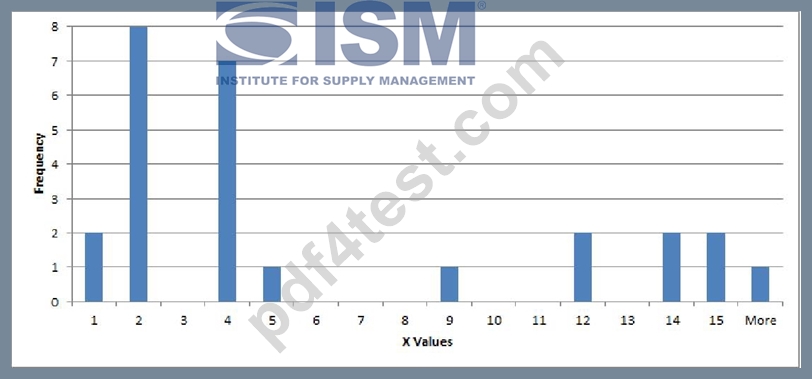
NEW QUESTION # 180
Which of the following financial statements is MOST useful in determining the capital expenditures of a company during the past year?
- A. The statement of retained earnings, using the profits that were reinvested in the company
- B. The balance sheet, using the ending balance of property, plant, and equipment
- C. The statement of cash flows, using the investing section
- D. The income statement, using the depreciation expense per year
Answer: C
NEW QUESTION # 181
Development of which of the following would be MOST beneficial for supplier technologies and processes important to the buying organization?
- A. Joint research and development team
- B. Supplier engagement forum
- C. Best practices solutions team
- D. Center of excellence
Answer: A
Explanation:
A joint research and development (R&D) team is most beneficial for developing supplier technologies and processes important to the buying organization. By forming a joint R&D team, both the buying organization and the supplier can collaborate closely to innovate and improve technologies and processes that are directly aligned with the organization's strategic goals. This collaboration fosters knowledge sharing, leverages combined expertise, and enhances mutual commitment to achieving advanced technological solutions and process improvements that benefit both parties. References:
* Monczka, R., Handfield, R., Giunipero, L., & Patterson, J. (2020). Purchasing and Supply Chain Management. Cengage Learning.
* ISM (Institute for Supply Management) resources on supplier collaboration and joint development.
NEW QUESTION # 182
BCD, Inc. manufactures a product for a highly regulated industry. All details of the product must be traceable.
The firm's engineering team specifies the types and quantities of materials within blueprints, but this is insufficient, as a record of material usage needs to be maintained. The product development group asks supply management to develop a system. Given this situation, which of the following is the BEST course of action for supply management to take?
- A. Request that the receiving and inventory management departments file packing slips for all deliveries
- B. Work with suppliers to ensure that test reports and certifications are provided for all materials
- C. Instruct the production team to verify the quantity and type of materials prior to processing
- D. Quarantine all inbound material for comprehensive mechanical and chemical testing prior to use
Answer: B
Explanation:
he BEST course of action for supply management to take in this situation is C. Work with suppliers to ensure that test reports and certifications are provided for all materials. This approach aligns with the need for traceability in a highly regulated industry, where it is crucial to have detailed records of material usage that can be traced back to the suppliers. Ensuring that suppliers provide test reports and certifications allows for a verifiable record of the materials' compliance with industry regulations and standards12.
NEW QUESTION # 183
The owner of a small hardware store learns that a large competitor is opening a store nearby. The new competitor has smaller profit margins on each unit than the small store but earns profits through larger volume. Which of the following techniques would BEST help the small store remain competitive?
- A. Improve service by hiring workers specializing in the maintenance of power tools
- B. Lower prices below variable cost
- C. Run advertisements showing how neighborhoods improve through individual home improvement
- D. Increase the size of the store
Answer: A
NEW QUESTION # 184
Which of the following measures can reduce multicollinearity in multiple regression? (Select all that apply.)
- A. Decrease the sample size
- B. Increase the sample size
- C. Remove the intercept
- D. Change the units of one of the independent variables
- E. Remove one of the collinear variables
Answer: B,E
NEW QUESTION # 185
The ability to explain how and why decisions are made in support of business plans is important because it allows a supply manager to
- A. align goals to supply management's mission
- B. influence internal stakeholders
- C. reduce the amount of needed input from key stakeholders
- D. prevent supply chain disruptions
Answer: B
NEW QUESTION # 186
A heavily populated town with many gas stations has an average price of $3.25 for a gallon of gasoline. However, one gas station charges $3.60 for a gallon of gasoline and remains very competitive in the market. Which of the following situations could NOT explain this gas station's success?
- A. The gas station offers a loyalty program through which customers can earn points toward future purchases.
- B. The gas station entered the market earlier than any of its competitors.
- C. The gas station offers a free car wash if customers purchase 10 or more gallons of gas.
- D. The gas station is in a convenient location for its customers.
Answer: B
NEW QUESTION # 187
To better reflect commodity purchasing costs for its consumer automotive division, a firm separates inventory purchasing into "repairable parts" versus "consumable parts." This is an example of
- A. market segmentation
- B. category management
- C. workload distribution
- D. spend analysis
Answer: B
Explanation:
* Understanding the Context: The firm differentiates inventory purchasing into "repairable parts" and
"consumable parts" for its automotive division.
* Category Management Definition: Category management involves dividing products into discrete groups or categories and managing each category as a business unit.
* Application to Inventory: By separating the inventory into repairable and consumable parts, the firm applies category management principles to better manage costs and supply chains tailored to each category's unique requirements.
References
* CIPS. (n.d.). What is Category Management?
* SCMDOJO. (n.d.). Benefits and Challenges of Category Management in Procurement.
NEW QUESTION # 188
A software design firm has traditionally done most of its work in-house, including support services and distribution management. The firm is planning a large expansion, and is evaluating how the various departments can support It. The chief executive officer (CEO) recommends concentrating on core competencies to increase the firm's agility and emphasize what differentiates them from competitors. Which of the following is the BEST way supply management can support this recommendation?
- A. Develop and implement an organization-wide strategic sourcing plan
- B. Conduct a spend analysis on strategic items
- C. Identify opportunities to outsource non-core business functions
- D. Develop better e-procurement processes
Answer: C
Explanation:
* Context: The firm is expanding and looking to concentrate on core competencies to increase agility and differentiate from competitors.
* Core Competencies: These are the unique capabilities that give a firm a competitive advantage.
* Supply Management's Role: To support the CEO's recommendation, supply management should focus
* on outsourcing non-core activities. This allows the firm to allocate more resources and focus on what they do best.
* Outsourcing: By identifying non-core functions that can be outsourced, the firm can become more agile, reduce costs, and improve efficiency.
* Evaluation: Conducting a spend analysis or developing better e-procurement processes are useful, but they don't directly address the CEO's strategy of focusing on core competencies. An organization-wide strategic sourcing plan is broader and less focused on core vs. non-core activities.
* Conclusion: The best way for supply management to support the recommendation is by identifying and outsourcing non-core business functions.
References
* Core Competency Theory by Prahalad and Hamel.
* Strategic Management of Supply Chains by David Simchi-Levi.
* Supply Chain Management: Strategy, Planning, and Operation by Sunil Chopra.
NEW QUESTION # 189
Which of the following is the BEST reason for inviting suppliers to visit a buying organization's facilities to meet with the company's stakeholders?
- A. To gain a better understanding of suppliers' constraints
- B. To better position supply management's influence in the manufacturing process
- C. To enhance the understanding between suppliers and internal customers
- D. To ensure the suppliers know which internal customers to contact at the buying organization
Answer: C
Explanation:
* Supplier Visits: Inviting suppliers to visit the buying organization's facilities provides them with firsthand experience of the operational environment and requirements.
* Enhanced Understanding: Direct interactions between suppliers and internal customers facilitate better communication, mutual understanding, and alignment of expectations.
* Building Relationships: This practice helps build stronger relationships, leading to better collaboration and more effective problem-solving.
* Operational Insights: Suppliers gain valuable insights into the buying organization's processes, which can help them tailor their products or services more effectively to meet specific needs.
References
* ISM. (n.d.). Supplier Relationship Management (SRM).
* CIPS. (n.d.). Enhancing Supplier Engagement and Collaboration.
NEW QUESTION # 190
What transaction is presented in the above journal entry?
- A. Rent paid in installments
- B. Amortization of prepaid rent
- C. Accrual for rent outstanding
- D. Payment of rent in advance
Answer: B
NEW QUESTION # 191
A company manager commissions a report to study the relationship between sales volume (in thousands of units) and the number of computers in each of the company's offices. Based on the regression output, which of the following statements is correct?
Exhibit: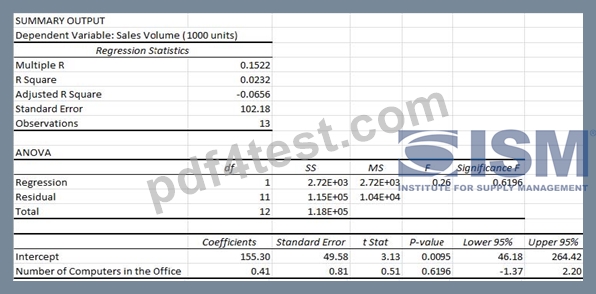
- A. When the number of computers in an office increases by 1, the average sales volume increases roughly by 155,000 units.
- B. There is a strong positive linear relationship between sales volume and number of computers in an office.
- C. Less than 3 percent of the variability of sales volume is explained by the number of computers in an office.
- D. When the number of computers in an office increases by 1, the average sales volume decreases by 410 units.
Answer: C
NEW QUESTION # 192
Consider the following supplier terms for the same product:
Supplier A:2%/15, Net 30
Supplier B:4%/5, Net 30
Which supplier's terms are more advantageous to the buying organization?
- A. The terms are equivalent
- B. Cannot be determined based on the above information
- C. Supplier A
- D. Supplier B
Answer: D
Explanation:
Supplier B's terms of 4%/5, Net 30 are more advantageous. This means a 4% discount is available if the invoice is paid within 5 days, whereas Supplier A offers a 2% discount for payment within 15 days. Paying early (5 days) to get a 4% discount is more beneficial in terms of cost savings compared to a 2% discount for paying within 15 days. The greater discount percentage within a shorter period represents better cash flow management and cost savings.
References:
* Financial Terms in Procurement
* Cash Flow Management Techniques in Supply Chain
NEW QUESTION # 193
Which of the following refers to a stakeholder want as opposed to a stakeholder need?
- A. Requiring thata supplierprovidedelivery schedules that meet the requirements specified inthe contract
- B. Requiring thata supplierprovidethe purchased component at or below the target cost
- C. Requiring thata supplierprovideaccommodations for the company's representatives duringvisits
- D. Requiring thata supplierprovidedetailed specifications for review for the supplied item
Answer: C
Explanation:
A stakeholder want refers to something that is desired but not essential for the completion of the task or project. In this case, requiring that a supplier provide accommodations for the company's representatives during visits is a want. It is not a core requirement for the supply of the component or service but is a preference that enhances convenience for the company's representatives.
References
* CIPS (Chartered Institute of Procurement & Supply). Differentiating Needs and Wants in Procurement.
* ISM (Institute for Supply Management). Understanding Stakeholder Requirements.
NEW QUESTION # 194
A supply manager Is seeking potential suppliers to recreate a now obsolete custom component. The supply manager identifies five suppliers who have the technology to manufacture the part. The supply manager wants to understand the capability of these suppliers prior to bidding. Which of the following should the supply manager use in this instance?
- A. E-Sourcing
- B. Collaborative optimization
- C. E-RFx
- D. E-Design
Answer: C
Explanation:
The supply manager should use E-RFx in this instance. E-RFx refers to electronic Request for Information (RFI), Request for Proposal (RFP), and Request for Quotation (RFQ). This process allows the supply manager to gather detailed information about the suppliers' capabilities, ensuring that they have the technology and capacity to recreate the obsolete custom component before moving forward with bidding. E-RFx helps in evaluating suppliers based on various criteria, including technical capabilities, financial stability, and past performance, providing a comprehensive understanding of each potential supplier.
References
* "Supply Management and Procurement: From the Basics to Best-in-Class," Robert W. Turner.
* "The Procurement and Supply Manager's Desk Reference," Fred Sollish and John Semanik.
NEW QUESTION # 195
......
The HBX CORe Final Examination is a rigorous test that requires learners to apply the knowledge they have gained throughout the program. CORe exam covers a wide range of topics, including financial statements, supply and demand, market structures, statistical analysis, and more. Learners who pass the exam demonstrate that they have a solid understanding of business concepts and are ready to apply these concepts in real-world situations.
The HBX CORe Final Examination is an essential component of the program, as it provides learners with an opportunity to demonstrate their mastery of the material covered in the program. It is also an excellent way for learners to gauge their progress and identify areas where they need to improve. CORe exam is challenging, but it is also fair, and learners who have studied diligently and taken the program seriously should be able to perform well. Ultimately, the HBX CORe Final Examination is an opportunity for learners to showcase their knowledge and skills and earn a credential that demonstrates their readiness for a career in business.
Easy Success ISM CORe Exam in First Try: https://validtorrent.pdf4test.com/CORE-actual-dumps.html
